
The CFOs capturing the most value from AI share 10 specific practices: they start with the problem before selecting any platform; they build a centralized, cloud-based data foundation before deploying anything; they use finance-specific tools for high-value use cases; they validate impact with historical comparisons before scaling; they govern AI rigorously rather than deploy it blindly; and they reskill their teams to interpret AI outputs not just receive them.
1. Start With the Problem, Not the Platform
The single most common failure pattern in AI adoption: a CFO buys a platform, then spends months searching for use cases to justify the purchase.
Reverse the sequence entirely.
Start with the three to five finance processes generating the most pain. the ones consuming analyst hours, producing stale outputs, or creating forecast errors that ripple downstream. Then ask whether AI can address those specific problems.
The CFOs getting the best ROI from AI entered every vendor conversation with a documented problem statement, not an open mind.
Define success metrics before you buy. If you cannot articulate what "better" looks like in measurable terms you do not have a use case. You have a hypothesis.
2. Centralize Your Data in the Cloud Before Deploying Anything
Data is the fuel for AI. And bad data does not get improved by AI, it gets scaled!
If your financial data lives in legacy on-premise systems, disconnected spreadsheets, or siloed business unit databases, your AI initiatives will underperform regardless of which platform you buy. The foundation must come first.
Centralize your financial data in a secure, cloud-based environment before any AI tool goes live. This means resolving inconsistencies across business unit definitions, building a data dictionary that documents field ownership and transformations, establishing a single source of truth for core financial metrics, and eliminating the manual overrides that quietly break audit trails.
A three-month data remediation effort before an AI deployment will produce more value than any feature upgrade after the fact.
Pro tip: The act of building a data dictionary alone surfaces systemic problems that have been distorting your numbers for years. It is the highest-ROI pre-deployment investment most finance teams never make.
3. Deploy Finance-Specific AI for Your Highest-Value Use Cases
Generic AI tools lack the financial context, data hierarchies, and internal controls required for FP&A. They require extensive configuration, produce outputs that confuse finance teams, and create explainability problems that undermine trust fast.
Choose purpose-built, finance-specific AI - tools that understand your data structures natively, integrate with your existing financial systems, and require no wholesale workflow overhaul to adopt.
The highest-ROI use cases in finance consistently cluster around four areas:
Forecasting and FP&A — AI-driven rolling forecasts, driver-based models, and scenario analysis that update in near real-time rather than on quarterly planning cycles. Business leaders demand updated scenarios faster than ever. AI-powered planning lets you run complex what-if models at scale — analyzing multiple variables simultaneously — without adding headcount.
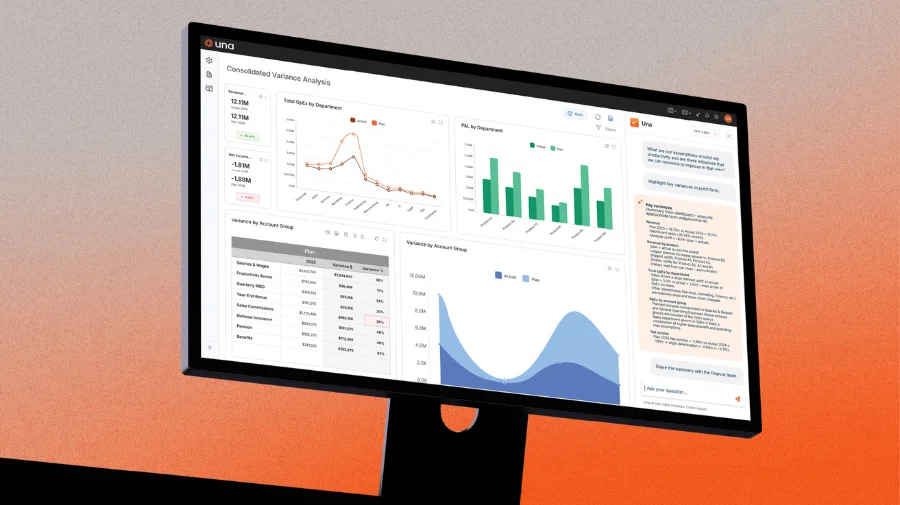
Anomaly detection and variance analysis — Systems that flag unusual spend patterns, budget deviations, and data integrity issues automatically before they cascade into downstream reporting problems. This shifts your team from data validation to data interpretation.
Accounts payable and receivable automation — Reducing manual touchpoints in invoice processing, approval workflows, and collections outreach.
Regulatory and tax compliance — AI-assisted documentation review, cross-jurisdictional tax analysis, and audit preparation.
Rank your use cases by two dimensions: strategic impact and data readiness. Prioritize the high-impact, high-readiness quadrant. Defer the rest.
4. Validate Impact with Historical Comparisons Before You Scale
Don't wait months for a pilot to prove its worth. The fastest way to build internal trust is to run a focused historical comparison before you commit to full deployment.
Take last quarter's manual forecast. Run the same inputs through your AI-enhanced model. Compare the outputs.
When the AI identifies the same red flags your team caught you have instant, irrefutable evidence of value. You also immediately understand where the model's judgment diverges from human judgment, which is exactly the conversation you need to have before the tool goes into production.
This practice accomplishes three things simultaneously: it validates the technology, it builds team confidence, and it identifies the model's edge cases before they show up in a board presentation.
Pro tip: Run the historical comparison exercise with your most skeptical analyst in the room. Their buy-in, once earned, will drive adoption faster than any top-down mandate.
5. Eliminate the Shadow AI Stack
When AI adoption lacks centralized governance, individual finance teams pull in their own tools. The FP&A team uses one AI forecasting platform. Treasury uses another. The controller's office builds something in-house. Within 18 months, you have a fragmented ecosystem with no shared data layer, no consistent security posture, and no way to aggregate insights across functions.
Establish an AI governance framework at the outset. This means: a defined approval process for new AI tools, a security and data privacy review requirement, a vendor management protocol, and a centralized repository of approved applications.
This is not bureaucracy. It is how you prevent the proliferation of point solutions that collectively cost more than an enterprise platform and produce far less.
Hidden trap: The shadow stack problem almost always starts at the manager level — not the executive level. A director approves a SaaS subscription, connects it to financial data, and the security review happens months later or not at all. Build the governance process to intercept at that layer.
6. Invest in People
AI tools fail far more often because of adoption problems than technical failures. And those adoption problems almost always trace back to two things most organizations treat as separate: fear of displacement and lack of capability.
Address both simultaneously.
Finance teams are analytical by nature, which means they are skeptical by nature. They will test AI outputs, find edge cases, and lose confidence the first time the system produces a number that looks wrong.
Build trust into the deployment process: run parallel outputs during a validation period, document cases where AI outperformed the manual process, build explainability into every AI output so analysts can trace the logic, and create a formal feedback mechanism for surfacing model errors.
At the same time, invest in structured AI literacy training across your finance team. This does not mean turning analysts into data scientists. It means ensuring every analyst understands what the model is doing, what its limitations are, and when to override it.
The finance leaders who frame AI adoption as making the finance team more strategic consistently see faster adoption, better feedback loops, and stronger long-term outcomes.
Hidden insight: The analysts who push back hardest on AI adoption often become its most effective internal advocates once they understand the mechanics. Engage your skeptics early, give them access to model documentation, and let them break it in a test environment. Their feedback improves the system. Their endorsement moves the organization.
7. Define Clear Boundaries Between AI Judgment and Human Judgment
AI adoption fails when teams don't know where the technology ends and their responsibility begins.
Define explicitly: where AI supports analysis, and where human judgment is absolute. Codify this in writing. Communicate it directly to your team.
Any AI output that feeds into a board presentation, an earnings forecast, a regulatory filing, or a capital allocation decision requires human review and sign-off. Do not assume this will happen by default, establish it as policy.
When your team understands the exact purpose and boundaries of the technology, they engage with it confidently rather than defaulting to old habits out of uncertainty. Clear boundaries do not constrain AI adoption.
8. Measure ROI Beyond Time Saved
Time savings are table stakes. If that is how you are measuring AI success, you are measuring the wrong thing.
Track metrics that impact the bottom line: forecast accuracy improvements over rolling 12-month periods, reduction in days to close, reduction in material audit findings, working capital freed through more precise cash flow forecasting, and the volume and quality of strategic insights generated per planning cycle.
Shift the narrative internally from efficiency to value creation. The finance function that can demonstrate AI's contribution to better capital allocation decisions, earlier risk identification, and faster strategic response is the one that earns continued investment — and board credibility.
Review these metrics quarterly. Kill initiatives that are not delivering within defined timeframes. Do not allow sunk cost to extend the life of underperforming tools.
Pro tip: Assign ownership of AI ROI measurement to a specific person — not a committee. Committees produce reports. Owners produce outcomes.
9. Establish Uncompromising Governance with Explainable AI
As AI scales across your finance function, governance is not optional. And governance means more than approving which tools get deployed.
You must know not just what the AI concluded — but exactly why.
Explainable AI (XAI) is non-negotiable in a finance context. Every model touching a material financial output should be documentable: what data it was trained on, what assumptions drive its outputs, how its accuracy has been benchmarked, and how it degrades over time as conditions change. Model drift, the gradual decline in predictive accuracy as market conditions shift, is a real risk that most finance governance frameworks do not yet address.
Layer in data privacy and security requirements: where data is stored and processed, whether the vendor uses your data to train their models, what the breach notification protocol is, and whether the tool meets your regulatory requirements across jurisdictions.
The EU AI Act, emerging SEC AI disclosure guidance, and state-level privacy laws are all evolving rapidly. Build compliance review into your governance process now, not after an audit forces the issue.
10. Position AI as a Strategic Differentiator
The CFO who gets ahead of the AI narrative — internally with the board, externally with investors and analysts — captures a disproportionate share of the credibility and capital that finance transformation creates.
Most CFOs underinvest here. They deploy tools, achieve results, and fail to connect those results to the organization's strategic positioning.
Tell the story proactively. Quantify the gains. Connect AI adoption to margin improvement, forecast accuracy, working capital optimization, and risk reduction. Frame it as a finance function transformation — not an IT project.
The CFO who can articulate, with data, how AI is changing the finance function's strategic contribution earns more budget, more board confidence, and a stronger seat at the table.
The Pro Tips Most Finance Leaders Skip
Discover more AI adoption tips and insights at https://www.una.ai/resources/blog
Ready to take control of your budgeting, planning, forecasting and reporting? Schedule a demo and see how Una’s financial planning & analysis software can work for you.
Schedule Demo


