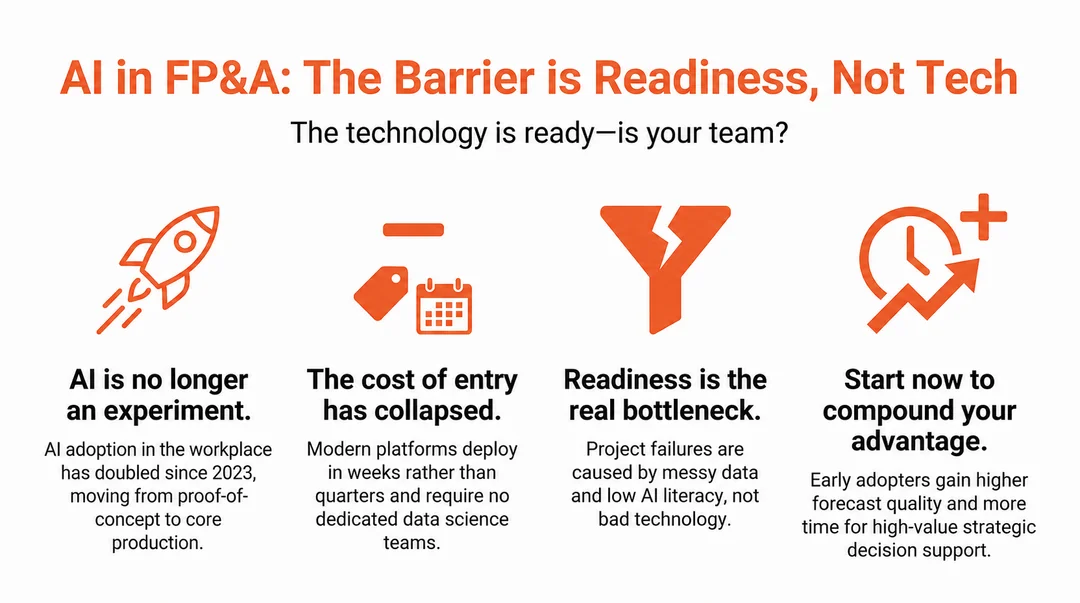
The tools are mature, entry costs have collapsed, and the actual bottleneck is team readiness, not technology. Teams that start now compound their advantage every quarter they're in the game.
For years, the standard advice on AI in FP&A was "wait for the technology to mature." That advice has expired.
1. The technology is no longer the experiment.
AI forecasting, variance analysis, and automated commentary have moved from proof-of-concept to production. Purpose-built, AI-native planning platforms now handle anomaly detection, driver-based forecasting, and natural-language analysis as core capabilities — not bolted-on afterthoughts. Gallup found AI adoption among U.S. workers has roughly doubled since 2023. The question is no longer whether the AI can do the work. It can.
2. The cost of entry has collapsed.
No data science team required. No six-figure, twelve-month implementation. Modern AI-native platforms are built for finance teams to run themselves — deployments measured in weeks, not quarters, without an army of consultants or heavy IT involvement. The barrier used to be budget and technical talent. Now it's simply a willingness to learn a new workflow.
3. The real gap is readiness, not technology.
Let's be real: teams struggling with AI aren't failing because the models are bad. They're failing because their data is messy, their processes are undocumented, and nobody's been trained to validate model output. The bottleneck moved from "can the AI do it" to "can your data and people support it." That's actually great news — data hygiene and AI literacy are things any FP&A team can start improving this quarter.
4. The payoff compounds for early movers.
Every AI use case a team ships makes the next one cheaper:
Meanwhile, teams still waiting for "the right moment" fall behind on all three fronts at once.
Here's the honest view for 2026: this isn't about replacing analysts. It's about which teams get their time back for the work CFOs actually value — business partnering, scenario thinking, decision support — and which teams stay buried in data prep.
Start small. Pick one high-friction workflow — variance commentary is a great first win — put real AI behind it, and measure the result. The AI is ready. Is your team?
If you want to see where your team stands today with AI, Una's AI Readiness Assessment is a good place to start.
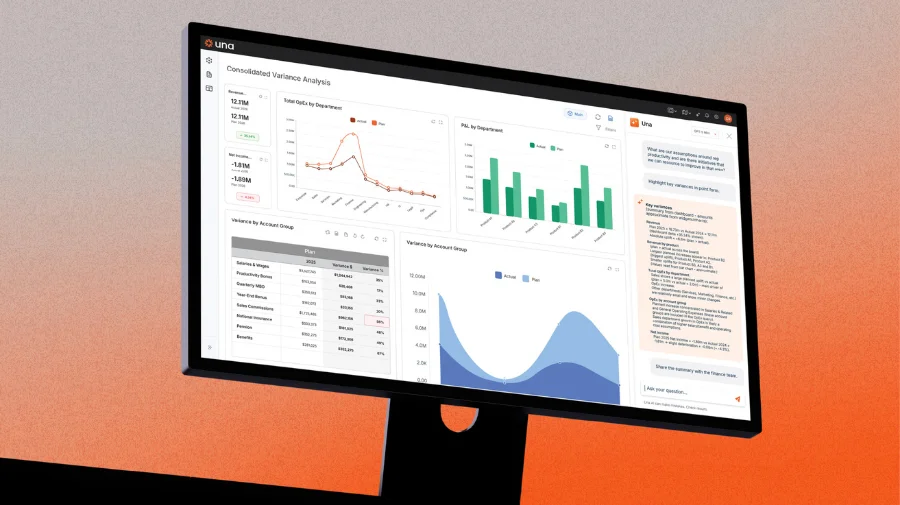
Ready to take control of your budgeting, planning, forecasting and reporting? Schedule a demo and see how Una’s financial planning & analysis software can work for you.
Schedule Demo