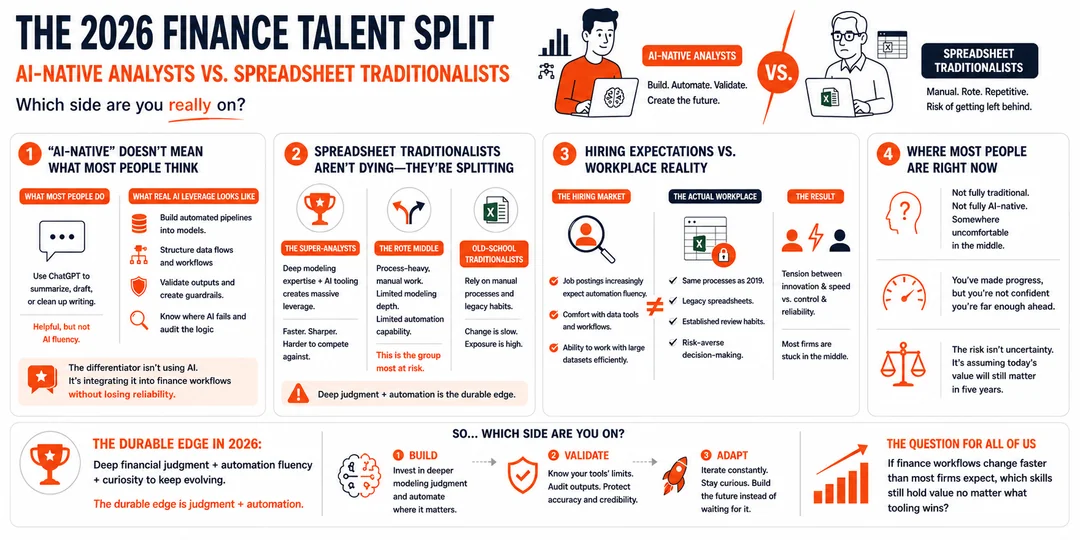
The “AI vs. Excel” debate in finance is real, but the framing is wrong. The actual divide isn’t between old-school spreadsheet people and futuristic prompt engineers. It’s between analysts who combine deep modeling judgment with automation, and the large middle layer of rote process work that’s getting squeezed from both sides.
Every few weeks someone posts a variation of:
“Excel monkeys are finished. AI is replacing finance analysts.”
It gets thousands of upvotes, everyone argues for two days, and then Monday comes around and most firms go right back to manually updating the same reporting packages they’ve used for years.
That disconnect is the interesting part.
Because something is changing in finance right now, pretty aggressively, but it’s not happening in the clean binary people online keep pretending it is.
“AI-native” doesn’t mean what most people think it means
A lot of finance professionals now consider themselves AI-native because they use ChatGPT or Claude to summarize filings, draft emails, or clean up writing.
That’s useful. But it’s not really AI fluency.
Real AI leverage in finance increasingly looks like workflow design:
The important skill isn’t “using AI.” Almost everyone can do that now.
The differentiator is whether you can integrate automation into actual finance workflows without losing reliability.
That’s a much narrower group of people than LinkedIn would have you believe.
Spreadsheet traditionalists aren’t disappearing, they’re splitting
The lazy narrative is that “Excel people are cooked.”
Honestly, I think the opposite is happening.
The strongest finance professionals I know are people with deep modeling instincts who adopted AI tooling early. They understand how a model should behave, where assumptions break, what outputs look suspicious, and how decision-makers actually consume information.
AI makes those people dramatically faster.
A strong modeler with automation skills is borderline unfair to compete against right now.
The people who seem genuinely exposed are the ones in the middle:
That layer of work is starting to look vulnerable in a way senior modeling expertise honestly doesn’t.
The hiring market and the actual workplace are completely out of sync
This is probably the strangest part of the whole transition.
Look at finance job postings right now:
A huge percentage now implicitly expect some level of automation fluency. Not necessarily full engineering skills, but definitely comfort with data workflows, tooling, and operating efficiently with AI systems.
But then you walk into the actual departments and a lot of teams still operate almost exactly like they did in 2019.
Same reporting structures.
Same spreadsheet dependencies.
Same approval chains.
Same macro-heavy files everyone is terrified to touch.
So now you have younger hires entering teams with the ability to automate large chunks of manual work, while senior leadership still often prefers processes built around legacy review habits.
That creates a weird kind of organizational tension:
Neither side is completely wrong, which is why the transition feels so messy internally.
Most finance professionals are stuck in the uncomfortable middle
That’s probably the real answer for most finance professionals right now.
Not fully traditional.
Not fully AI-native.
Not convinced the old system survives untouched.
Not convinced the new one is stable enough to trust blindly either.
Maybe you’ve automated parts of your workflow but still don’t fully trust the outputs.
Maybe you’re a strong modeler but know your tooling skills lag behind.
Maybe you understand AI conceptually but haven’t meaningfully integrated it into your actual work.
That uncertainty honestly feels rational to me.
What seems riskier now is assuming your current workflow will still be valuable in five years just because it’s valuable today.
The weirdest part is that most finance teams now have all three groups sitting next to each other:
If finance teams look materially different 3–5 years from today, what skills still hold value no matter what tooling wins?
Una AI helps FP&A and strategic finance teams move beyond spreadsheet‑only workflows into reliable, AI‑assisted ones. If you want to see where your finance function actually sits on that maturity curve, you can take our free AI readiness benchmark at benchmark.una.ai
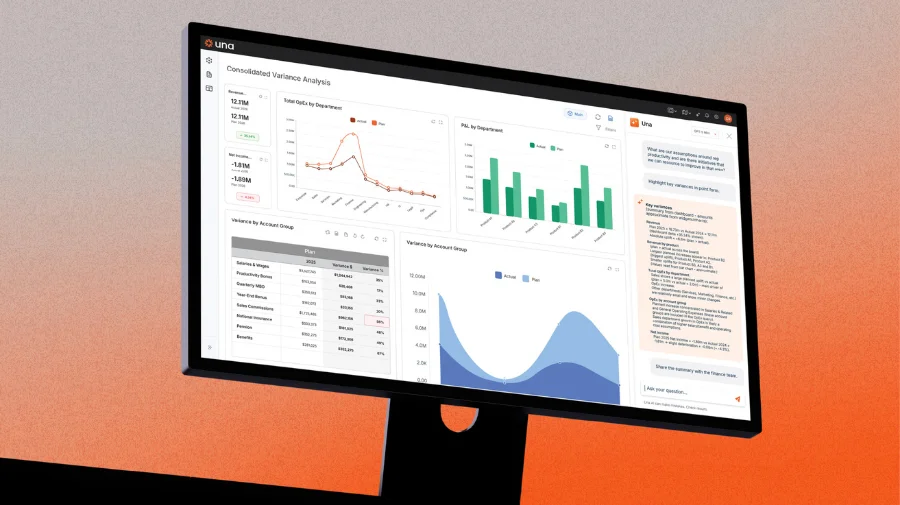
Ready to take control of your budgeting, planning, forecasting and reporting? Schedule a demo and see how Una’s financial planning & analysis software can work for you.
Schedule Demo