AI fundamentally changes variance analysis from a 15-hour data entry exercise into a 20-minute strategic review. Finance teams using AI correctly cut commentary time by 80% and surface root causes 3x faster. This playbook details the framework to shift your team from explaining the past to driving the future.
Most Finance Teams Are Still Doing Variance Analysis the Hard Way.
Variance analysis is the backbone of every FP&A team's monthly deliverable. It is also the single biggest time sink in the close cycle. The average FP&A professional spends 12 to 18 hours per month just on variance commentary. That is not building models, not scenario planning. It is writing sentences explaining why headcount came in 3% over plan.
Why Variance Analysis Is the Perfect AI Use Case
Variance analysis has a specific structure making it ideal for AI augmentation. It is repetitive, pattern-based, narrative-heavy, and requires synthesis. AI handles all four aspects simultaneously. What can take a senior analyst four hours, a well-prompted AI workflow drafts in 20 minutes at a quality level requiring only refinement, not reconstruction.
The Best Practices That Separate Good AI Variance Work from Great AI Variance Work
Top Use Cases by Function
FP&A: Monthly Flash Commentary
Use AI to generate first-draft variance commentary for every P&L line within 30 minutes of actuals close. Feed it actuals, plan, prior year, and a context brief. Output requires editing, not writing.
CFO Office: Board and Executive Variance Packages
AI excels at synthesizing multi-level variance data into executive-appropriate language. Prompt for the so what framing, not just description. Every paragraph must answer: what happened, why it happened, and what it means for the full-year outlook.
Business Unit Finance Partners: Real-Time Variance Monitoring
Rather than waiting for month-end, use AI to run rolling variance checks against budget weekly. This shifts business partner conversations from reactive to proactive.
The Hidden Things Most Finance Teams Get Wrong
They use AI as a word processor, not an analyst. The most common mistake is using AI only to clean up manually written commentary. The real leverage is using AI to do the analytical work—driver identification, pattern analysis, forward implications—before a human writes a single word.
They skip the context brief. Without a context brief, AI variance commentary reads like it was written by someone who has never worked at your company. With a context brief, it reads like a senior FP&A analyst who has been there for years.
They accept the first output. AI variance commentary benefits from iteration. A second prompt revising the commentary to be more concise and lead with the most important driver consistently produces materially better output.
The Benchmark That Changes How You Think About This
Finance teams fully operationalizing AI variance analysis report an 80% reduction in time spent on variance commentary drafting and a 40% improvement in the quality of root cause identification.
The takeaway is not that AI does the work. The takeaway is that AI expands what is analytically possible within the same headcount. That is what strategic finance looks like in 2026. Stop writing commentary and start driving strategy.
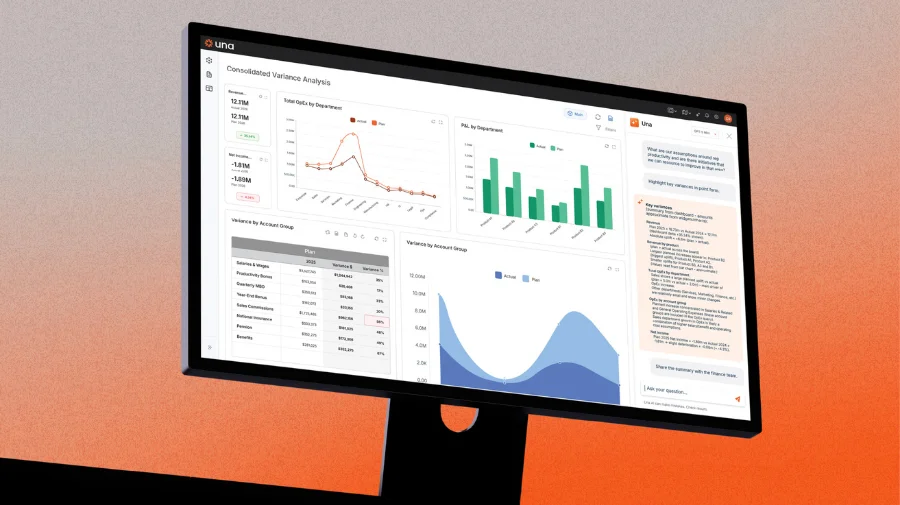
Ready to take control of your budgeting, planning, forecasting and reporting? Schedule a demo and see how Una’s financial planning & analysis software can work for you.
Schedule Demo