
Most finance teams are deploying AI for data cleanup and report formatting. That's a productivity win, not a strategic transformation. The CFOs who are pulling ahead are using AI to compress the time between raw data and forward-looking insight, and they're doing it across the full FP&A cycle, not just in isolated pockets. This post breaks down the full playbook: 14 use cases, the best practices that separate signal from noise, pro tips most teams miss, and the hidden capabilities that will define the next generation of FP&A leadership.
Your Team Is Solving the Wrong Problem with AI
Here's the uncomfortable truth: if your AI rollout started and ended with automating variance commentary and cleaning up Excel, you've automated the symptom, not the disease.
The disease is that finance teams spend the majority of their time on data assembly, reconciliation, and formatting, work that produces zero insight. AI fixes that, but that's the floor, not the ceiling.
The ceiling is a finance team that operates as a real-time strategic intelligence unit: running continuous scenario analysis, surfacing risks before they hit the P&L, and delivering forward-looking guidance that shapes operating decisions, not just explains historical ones. The gap between where most teams are and where the top 10% operate is real, measurable, and closeable.
The 5-Layer AI Framework for FP&A
Before the use cases, the architecture matters. High-performing AI-enabled finance functions are built in layers:
Layer 1 — Data Unification: AI normalizes, reconciles, and structures data from ERP, CRM, HRIS, and operational systems into a single analytical layer. This is table stakes.
Layer 2 — Automated Monitoring: Continuous variance detection, anomaly flagging, and threshold-based alerts that eliminate the need for manual period-end reviews.
Layer 3 — Intelligent Forecasting: Rolling forecasts powered by ML models trained on internal and external signals - replacing static annual plans with dynamic, probability-weighted projections.
Layer 4 — Scenario Intelligence: Rapid multi-variable scenario modeling that lets finance teams stress-test assumptions and present decision-ready analysis to leadership within hours, not days.
Layer 5 — Narrative Generation: AI-drafted commentary, board packages, and executive summaries grounded in the data, reviewed and refined by finance, not assembled from scratch.
Most teams are operating at Layer 1 and 2. Strategic value lives at Layers 3 through 5.
14 High-Impact AI Use Cases in FP&A
Forecasting and Planning
1. Rolling Forecast Automation Replace the static annual budget with a continuously updated rolling forecast. AI ingests actuals, pipeline data, and macroeconomic indicators to refresh projections weekly. Teams that do this reduce planning cycle time by 40-60% and improve forecast accuracy significantly within the first year.
2. Driver-Based Modeling at Scale AI identifies the 8-12 leading indicators that most reliably predict revenue, margin, and cash flow in your specific business. It builds and maintains driver-based models that update automatically as those inputs change — eliminating the manual model maintenance that consumes analyst bandwidth.
3. Probabilistic Scenario Planning Move beyond base/bull/bear scenarios. AI can generate probability-weighted outcome distributions across dozens of variables simultaneously — giving leadership a genuine view of risk exposure rather than three arbitrary data points.
4. Zero-Based Budgeting Acceleration ZBB is analytically rigorous but operationally brutal without AI. AI automates the benchmarking, variance flagging, and justification analysis that makes ZBB viable at scale without burning out your team.
Close and Reporting
5. Automated Variance Analysis AI writes the first draft of variance commentary, comparing actuals to budget, prior period, and forecast, and generating plain-language explanations grounded in the data. Finance reviews and refines. This alone reclaims 15-20 hours per close cycle across a mid-size team.
6. Anomaly Detection in the Close AI monitors journal entries, intercompany transactions, and accruals in real time during the close, flagging statistical outliers for review before they become audit findings. This is the risk-reduction use case that gets CFOs' attention immediately.
7. Board Package and Narrative Drafting AI drafts the management discussion and analysis sections, the executive summary, and the KPI narrative for board packages. The finance team's job shifts from writing to editing, compressing a 2-3 day process into hours.
8. Consolidation Automation For organizations with multiple entities, currency exposures, or complex intercompany eliminations, AI handles the mechanical consolidation work and flags exceptions for human review.
Business Partnering and Strategic Analysis
9. Margin Optimization Analysis AI surfaces margin leakage at the SKU, customer, channel, and geography level, identifying the 20% of revenue mix that's destroying blended margins. This analysis is theoretically available in most BI tools. AI makes it actionable by contextualizing it and connecting it to pricing and cost levers.
10. Headcount and Workforce Analytics AI models the P&L impact of hiring plans, attrition scenarios, and compensation changes, integrating HRIS data with financial models to give CFOs a real-time view of the true cost and productivity impact of workforce decisions.
11. Capital Allocation Intelligence AI continuously evaluates the ROI of capex projects, M&A targets, and R&D investments against actual performance, creating a feedback loop that improves capital allocation decisions over time.
12. Working Capital Optimization Predictive models for receivables, payables, and inventory that identify cash conversion cycle improvements and flag collection risks before they become cash flow problems.
Risk and Compliance
13. Real-Time Risk Monitoring AI monitors covenant compliance, FX exposure, interest rate sensitivity, and liquidity ratios on a continuous basis, alerting finance when thresholds are approaching rather than after they've been breached.
14. Regulatory Change Impact Analysis AI monitors regulatory publications and flags changes with material P&L or balance sheet impact, compressing the research-to-assessment cycle from weeks to hours.
Best Practices: What Separates Results from Regret
Start with a data audit, not a tool selection. The most common AI implementation failure is deploying a sophisticated tool on top of unreliable data. Your AI output is only as trustworthy as your data foundation. Before any vendor evaluation, assess data completeness, consistency, and lineage across your key systems.
Define the decision before you build the model. Every AI model in finance should be anchored to a specific decision: What will we do differently with this output? If you can't answer that question, you're building analytical infrastructure for its own sake.
Finance owns the model logic, not IT. The teams getting the most value from AI in FP&A are the ones where finance professionals understand and can interrogate the underlying model assumptions. Black-box AI in financial planning creates dependency and destroys trust with leadership.
Measure accuracy, not just efficiency. The obvious win from AI is time savings. The durable win is forecast accuracy improvement. Track MAPE (Mean Absolute Percentage Error) before and after AI implementation. A 5-point improvement in forecast accuracy is worth more to the business than 10 hours of analyst time per month.
Run the human review layer in parallel, not after. The most effective AI-enabled finance teams don't treat AI output as a final product. They run human review concurrent with AI generation, catching outliers faster and building institutional trust in the system.
Pro Tips Most Teams Miss
Tip 1: Use AI to pre-empt board questions, not just answer them. The best CFOs are using AI to run an adversarial analysis on their own board materials before the meeting, essentially asking the model: what are the three most likely challenges to this forecast? What assumptions are most exposed? This prep changes the quality of board conversations.
Tip 2: Train your models on your own historical data before deploying vendor benchmarks. Off-the-shelf benchmarks are directionally useful. But AI models trained on your own historical variance patterns, seasonality, and business rhythms will outperform generic models significantly within 2-3 planning cycles.
Tip 3: Use natural language querying to democratize financial data access. Most BI tools require SQL or structured navigation to get answers. AI-powered NLQ (natural language query) lets business partners ask financial questions in plain language and get instant answers, reducing ad hoc finance team requests by 30-50% at organizations that deploy it well. Finance stops being a reporting bottleneck and starts being a strategic resource.
Tip 4: Build AI into the close checklist, not just the output. Teams that use AI only at the end of the close process to draft commentary miss the bigger opportunity: AI monitoring throughout the close that catches issues in real time. Wire AI into your close checklist so it's validating data integrity at each stage, not just summarizing at the end.
Tip 5: Measure the strategic time dividend. The ultimate metric for AI in FP&A is not cost savings or headcount reduction. It's the percentage of finance team time spent on forward-looking strategic analysis versus backward-looking reporting. World-class finance teams are targeting 70%+ forward-looking. Measure where you are today before you start, and track it quarterly.
Hidden Things Most Finance Teams Miss
The compounding accuracy effect. AI forecasting models improve with each planning cycle as they accumulate more data on your specific business patterns. Most teams evaluate AI ROI after 90 days. The real ROI emerges at 12-18 months when the models have enough history to identify non-obvious patterns. Patience here is a competitive advantage.
AI as a control environment strengthener. Most CFOs think of AI in the context of efficiency or analysis. A smaller number are using it to strengthen the internal control environment, specifically, using AI to monitor for unusual journal entry patterns, segregation of duties violations, and anomalous approval sequences.
The FX and macro signal layer. Advanced FP&A teams are feeding external signals (e.g. interest rate curves, commodity futures, FX forward rates, and sector-specific economic indicators) directly into their forecasting models. The AI connects macroeconomic movements to your specific P&L drivers in ways that manual models simply can't do at speed.
The organizational memory problem. When an experienced FP&A analyst leaves, they take institutional knowledge with them, the context behind historical variances, the nuance in the budget assumptions, the story behind the numbers. AI systems that capture, tag, and surface that institutional context become a genuine competitive asset as team composition changes over time.
Prompt engineering is now an FP&A skill. The quality of AI-generated financial analysis is directly proportional to the quality of the prompts driving it. Teams that invest in teaching their analysts how to write precise, context-rich prompts get dramatically better output than teams treating AI as a simple question-and-answer tool.
The Strategic Framing That Changes Everything
The CFOs getting the most value from AI are not thinking about it as a technology implementation. They're thinking about it as a structural redesign of how finance creates value.
The old model: finance assembles data, produces reports, explains the past.
The new model: AI assembles data and produces reports. Finance explains the future, challenges operating assumptions, and drives strategic decisions.
That shift requires more than software. It requires a deliberate reallocation of what your team works on, how business partners interact with finance, and what success looks like for the function.
The teams that make that shift deliberately and quickly will have a structural advantage over the ones that don't. That advantage compounds.
The question for every CFO in this community is not whether AI will transform your finance function, it already is! The question is whether you're driving that transformation or reacting to it. If you're ready to drive transformation, see what Una.ai can do for you. Una's solutions for revenue planning, scenario modeling, and budgeting and forecasting can jumpstart your transformation. Schedule a demo to find out more.
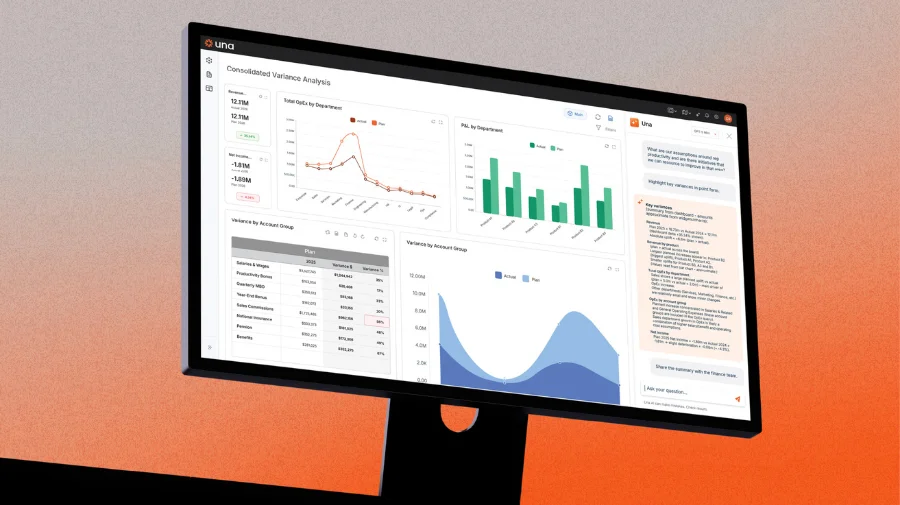
Ready to take control of your budgeting, planning, forecasting and reporting? Schedule a demo and see how Una’s financial planning & analysis software can work for you.
Schedule Demo