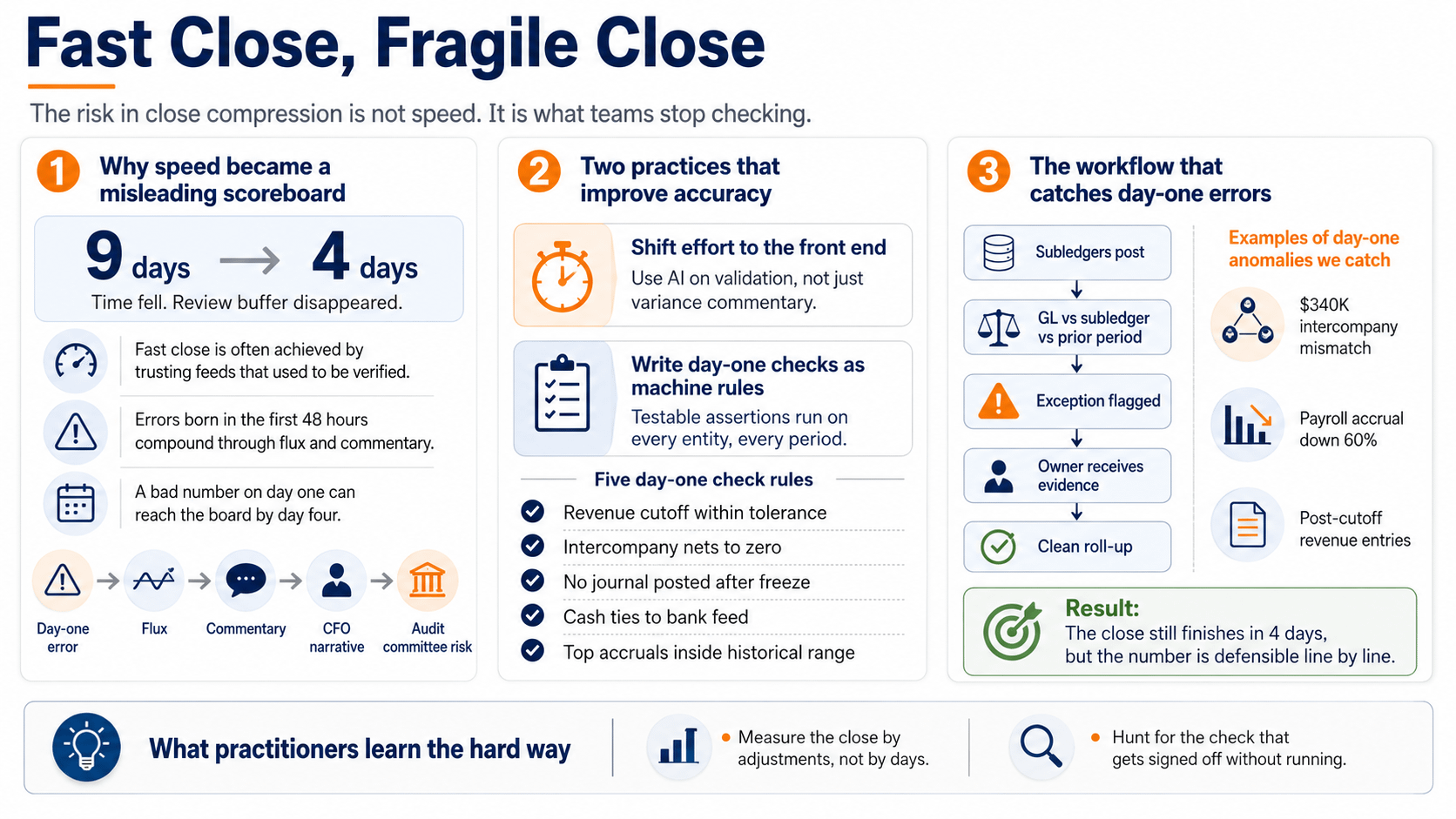
Compressing the close is the metric every finance team brags about and the one that hides the most risk. Speed only matters if the numbers you open with are right, and most fast closes are fast because the team stopped re-checking the source data that lands in the first 48 hours. The move is to shift your effort and your AI from the back end of close, where you are polishing commentary, to the front end, where a bad accrual, a missing intercompany entry, or a broken feed sets the entire close on the wrong foundation. Two practices below and one real workflow that catches the day-one errors before they compound.
Speed became the scoreboard, and accuracy fell off the deck
Walk into any FP&A offsite and someone will announce they took the close from nine days to four, and the room nods like that settles the question. It does not. A four-day close that opens on a bad revenue cutoff is not a win, because you have simply arrived at the wrong number two business days sooner and given yourself less time to notice. The dirty secret of close compression is that most of the days you cut came out of the review buffer, not out of genuine inefficiency, and the review buffer is exactly where late-breaking errors used to get caught.
Every experienced controller knows where the real exposure sits. It is the first 48 hours: the subledgers loading, the accruals posting, the intercompany entries matching or failing to match, the bank feeds reconciling. Errors born in that window do not stay small. A misclassified 2 million dollar receipt on day one flows into the flux, the flux drives the commentary, the commentary shapes what the CFO tells the board, and by the time anyone traces it back you have restated a number in front of the audit committee. Speed did not cause that. Speed just removed the slack that would have surfaced it on day six.
Move the interrogation to the front, where the errors are still cheap
The first practice is to stop pointing your best analysts and your AI at the end of the process. Most teams deploy automation on the glamorous back-end tasks: drafting variance narratives, formatting the board deck, summarizing results. That is where the work is visible, so that is where the tools go. The money in accuracy sits at the front, on the unglamorous validation nobody wants to own, and that is precisely the work AI is suited to run at scale the moment the ledger opens.
The second practice is to define your day-one checks as explicit, testable assertions rather than tribal knowledge living in one senior person's head. Write them down as rules the machine can enforce the instant the data lands:
Once those checks exist as rules, they run on every entity, every period, without waiting for the analyst who usually eyeballs them to get to that tab. A veteran will recognize the value immediately, because these are the exact checks that used to happen informally on day five and now happen automatically on day one.
The workflow that catches the day-one error before it reaches the flux
Consider a multi-entity close, illustratively, across eight legal entities feeding a consolidated P&L. The old sequence let each entity close locally, rolled everything up, and discovered the problems during consolidation review late in the week. The reordered sequence looks different.
The moment subledgers post on day one, an automated pass reconciles three things against each other for every account: the GL, the source subledger, and the prior-period baseline. It surfaces the anomalies that matter:
Each exception routes to the owner with the evidence attached, so the person who can fix it sees it on day one with context rather than getting a vague query on day four. The consolidation review, when you reach it, is confirming a clean roll-up instead of hunting for what broke. The close still finishes in four days. The difference is that the four-day number is now one you can defend line by line.
What nobody says out loud about the fast close
Here is the part that does not make it into the LinkedIn post about your four-day close. A meaningful share of that speed came from people deciding to trust feeds they used to verify, because verifying them no longer fit the new timeline. The close got faster and the number of controls that actually fired got smaller, and the two facts are related. Nobody flags it, because the close still looks clean until the one period it does not, and by then the compressed timeline that made you look efficient is the same timeline that gives you no room to recover.
Two things a practitioner learns the hard way here:
This is where do-it-yourself accuracy programs stall, because the GL, the subledgers, the bank feeds, and the operational systems live in different places and get reconciled by hand, which is the very manual step you were trying to compress. A platform like Una that unifies those source systems into a single live source of truth is what lets the day-one validation run continuously and against numbers that actually agree, so the AI is checking reality rather than checking one more copy that has already drifted.
Your close time is a number your board likes and your auditor ignores, and the two of them are telling you something. If you cut days out of your close in the last year, how many came out of genuine automation and how many came out of controls you stopped running, and could you name which reconciliations actually fired this period without going to look?
Looking for ways to make your close more efficient while maintaining financial controls? Ask Agent Una for advice!
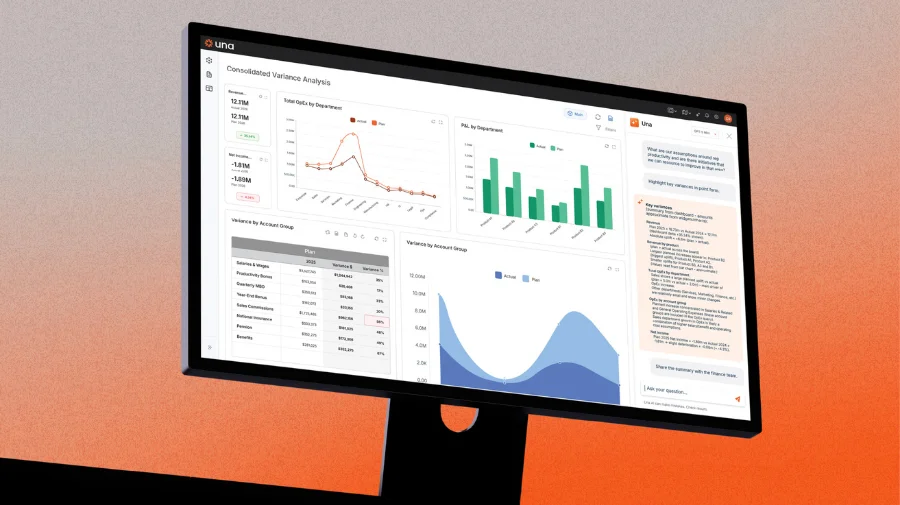
Ready to take control of your budgeting, planning, forecasting and reporting? Schedule a demo and see how Una’s financial planning & analysis software can work for you.
Schedule Demo