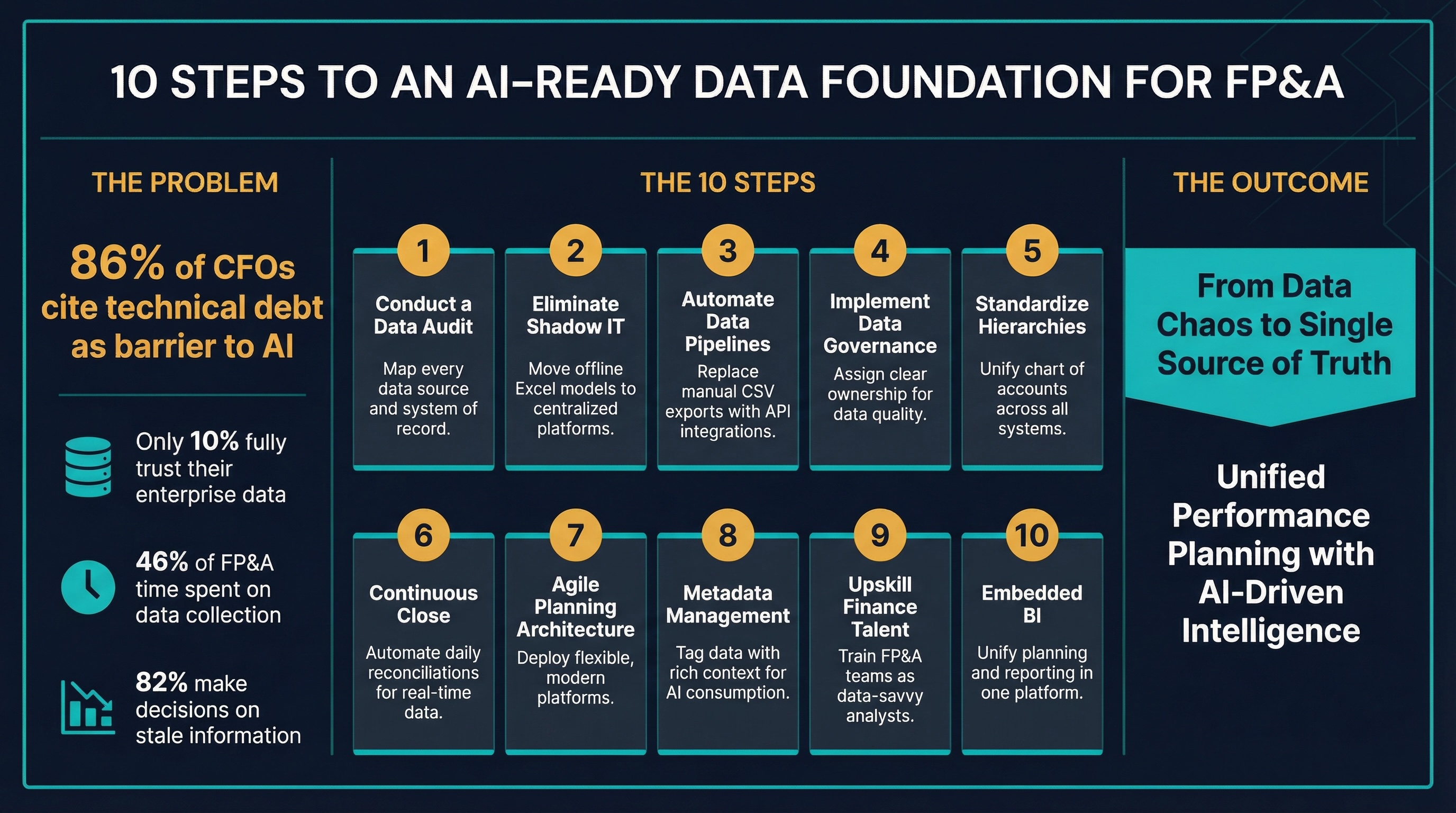
Eighty-six percent of CFOs cite technical debt as the primary barrier to AI adoption, and the root cause is data fragmentation. Before you can deploy predictive models or AI co-pilots, you must build a unified data foundation. Here are ten actionable steps finance teams must take to eliminate data silos, escape spreadsheet chaos, and prepare their infrastructure for true AI-driven Performance Planning.
The mandate from the board is clear: implement AI to drive efficiency. But when you look at your actual finance infrastructure, you realize you are trying to build a skyscraper on a foundation of sand.
Recent data confirms this reality. According to a December 2025 survey of two hundred CFOs, eighty-six percent report that technical debt and legacy systems are actively limiting their AI readiness. Even more alarming, only ten percent of finance leaders say they fully trust their enterprise data.
You cannot train a predictive forecasting model on fragmented spreadsheets, inconsistent CRM extracts, and siloed ERP data. If you feed garbage into a sophisticated AI model, you just get garbage out faster. The number one bottleneck to AI adoption in FP&A is not a lack of technology or budget; it is data fragmentation.
The Cost of Fragmented Finance
The reality for most mid-market and enterprise finance teams is a landscape of disconnected systems. Sales data lives in Salesforce, headcount data in Workday, operational metrics in Snowflake, and the actual financial truth is scattered across seventy different Excel workbooks that only three people know how to update.
The reconciliation tax is destroying productivity. Industry studies show that FP&A teams spend forty-six percent of their time simply collecting and validating data. Only seven percent of their time is spent on actual analysis. When you have eight different data categories and ten reporting tools, simply agreeing on the baseline numbers becomes a multi-day negotiation. Your highly paid analysts are functioning as overqualified data janitors, manually stitching together CSV files instead of uncovering the strategic insights that drive growth.
Stale data drives poor strategy. Eighty-two percent of companies admit to making decisions based on stale information. When it takes three weeks to close the books and consolidate the forecasts, your leadership team is steering the company by looking exclusively in the rearview mirror. By the time the variance analysis is complete, the market has shifted, the competitors have moved, and the opportunity to intervene has vanished. In a dynamic economic environment, latency is a competitive disadvantage.
The illusion of AI readiness. Many finance leaders purchase expensive AI tools expecting instant transformation. But when the AI attempts to analyze the data, it encounters conflicting naming conventions, duplicated records, and undocumented assumptions hidden in spreadsheet cells. The project stalls, ROI plummets, and the finance team retreats to manual processes. You cannot buy your way out of bad data hygiene. The foundation must be fixed first.
The Shift to Unified Performance Planning
The paradigm is shifting from traditional, siloed FP&A to unified Performance Planning. The most successful finance teams are recognizing that data architecture is not just an IT problem; it is a core finance competency.
The goal is no longer just to generate a budget. The goal is to create a Single Source of Truth that connects revenue intelligence, operational metrics, and financial outcomes in real-time. When your data is unified, AI ceases to be a buzzword and becomes an embedded co-pilot that can instantly explain variances, generate predictive scenarios, and track execution against strategic goals.
This shift requires moving away from the brittle, disconnected spreadsheets of the past and embracing platforms that natively integrate data ingestion, modeling, and reporting. It requires a fundamental rethinking of how data flows through the organization, from the initial transaction in the ERP to the final dashboard presented to the board.
10 Steps to Build an AI-Ready Data Foundation
If you want to move beyond the hype and actually deploy AI-driven FP&A, you must fix the plumbing first. Here are ten actionable steps CFOs and finance leaders can take to eliminate fragmentation and build a trusted data foundation.
1. Conduct a brutal data audit. Map every single data source that feeds your financial models. Identify the system of record for every metric. If you have three different definitions for Annual Recurring Revenue across sales, marketing, and finance, force a leadership decision to establish one standard definition. Document the flow of data from inception to reporting, and identify every manual intervention point.
2. Eliminate shadow IT spreadsheets. Identify the offline Excel models that are secretly running critical business processes. You cannot govern data that lives on a local hard drive. Transition these offline models into a centralized, cloud-based planning environment where data flows automatically and version control is enforced by the system, not by file naming conventions.
3. Establish automated data pipelines. Stop manually exporting CSV files from your ERP and importing them into your planning tool. Invest in direct API integrations. The moment human hands touch the data transfer process, you introduce latency and the potential for error. Automation ensures that your planning models always reflect the most current operational reality.
4. Implement strict data governance. Assign clear ownership for data quality. The sales operations team must own the hygiene of the CRM data, and HR must own the headcount roster. Finance should consume trusted data, not clean it. Establish data quality metrics and hold the operational teams accountable for maintaining the integrity of their source systems.
5. Standardize your dimensional hierarchies. Your chart of accounts, department structures, and product categories must be consistent across all systems. If your ERP categorizes regions differently than your CRM, your AI models will fail to correlate revenue drivers with financial outcomes. Build a master data management strategy that enforces consistency across the enterprise architecture.
6. Move to a continuous close mindset. Shift away from the massive month-end data scramble. By automating daily reconciliations and integrating operational data continuously, you maintain a perpetually clean dataset that AI can analyze in real-time. This transforms the close process from a stressful event into a non-event, freeing up the team to focus on forward-looking analysis.
7. Adopt an agile planning architecture. Legacy systems require months to reconfigure when business models change. Implement modern, agile platforms that allow you to quickly adjust data models, add new dimensions, and pivot forecasts without requiring a massive IT intervention. Your data architecture must be as dynamic as the market you operate in.
8. Focus on metadata management. AI needs context to understand numbers. Ensure that your data includes robust metadata tagging. A revenue number is just a number; a revenue number tagged with product line, sales rep, region, and contract type is a rich dataset ready for machine learning analysis. The more context you provide, the more accurate the predictive models will be.
9. Upskill your finance talent. Sixty-eight percent of CFOs cite skills gaps as a major barrier. Train your FP&A team to think like data engineers. They need to understand relational databases, data flow architecture, and how to structure data specifically for machine learning consumption. The FP&A professional of the future is a hybrid of a financial analyst and a data scientist.
10. Deploy embedded Business Intelligence. Stop separating your planning tools from your reporting tools. When you use a unified platform that combines dynamic forecasting with embedded BI, you ensure that the data you are analyzing is exactly the same data you are planning against. This eliminates the disconnect between the operational dashboards and the financial models.
Pro Tips and Hidden Insights Most Teams Miss
Beyond the foundational steps, elite finance teams understand a few critical nuances about AI adoption that most organizations miss entirely.
The difference between structured and unstructured data. Most FP&A teams only focus on structured financial data from the general ledger. But the real predictive power of AI comes from combining that structured data with unstructured operational signals. Analyzing customer support ticket volume alongside revenue retention metrics provides insights that pure financial data never will. The best AI models look for correlations across the entire business ecosystem, not just the financial silo.
Execution tracking is the missing link. You can generate the most accurate AI forecast in the world, but if you do not track the execution of the actions required to hit that forecast, the model is useless. The best systems bridge the gap between planning and execution, assigning ownership to specific variances and tracking the resolution. If the AI identifies a shortfall in the European sales pipeline, the system must immediately trigger a workflow for the regional VP to address the gap.
The Black Box problem. When deploying AI models for financial forecasting, explainability is non-negotiable. If an AI predicts a twenty percent drop in Q3 revenue, the CFO must be able to explain exactly which variables drove that prediction. Always prioritize AI solutions that offer transparent logic and clear audit trails over opaque, proprietary algorithms. You cannot defend a forecast to the board if you do not understand how it was generated.
Start with augmented intelligence, not artificial intelligence. Do not attempt to replace your entire forecasting process with an autonomous AI model on day one. Start by using AI to augment your existing team. Use it to identify anomalies in the data, suggest baseline forecasts for stable product lines, and automate the narrative generation for the monthly management reporting. Build trust in the system incrementally.
What to Do Next
The window to build a competitive advantage through AI is closing. The companies that solve their data fragmentation issues today will dominate their markets tomorrow. Here is your immediate action plan:
The future of finance belongs to the teams that control their data. AI is not a magic wand that fixes broken processes; it is a magnifying glass that amplifies your foundational infrastructure. By eliminating data fragmentation and building a unified, trusted data architecture, you transform your FP&A team from historical scorekeepers into strategic, forward-looking business partners. The technology is ready. The question is, is your data?
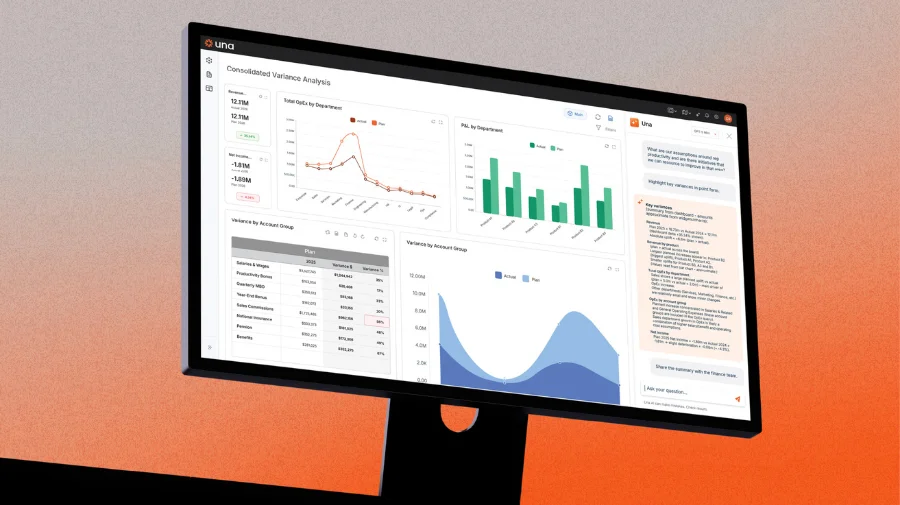
Ready to take control of your budgeting, planning, forecasting and reporting? Schedule a demo and see how Una’s financial planning & analysis software can work for you.
Schedule Demo