The transition from accounting to FP&A has always been a proven path to higher compensation, but in 2026, AI skills have supercharged that premium. With AI adoption in FP&A surging from six percent to forty-seven percent in just one year, hybrid finance professionals are commanding salary premiums of up to twenty-four percent. Here is the exact roadmap to leverage your accounting foundation, bridge the AI skill gap, and land a high-impact, high-paying FP&A role this year.
If you are currently working in accounting, you are sitting on a goldmine of transferable skills. You understand the fundamental mechanics of business better than anyone else in the organization. You know how the three statements connect, you understand the nuances of the month-end close, and you have the discipline required to reconcile complex data sets.
But if you are feeling overworked, underappreciated, and disconnected from the strategic decisions driving the company forward, you are not alone. A recent survey revealed that forty-two percent of mid-career finance professionals feel overworked and stuck in historical reporting. You spend your days looking in the rearview mirror, making sure the numbers tie out, while the FP&A team gets to look through the windshield and steer the company.
The good news is that the exit path has never been clearer, and the financial upside has never been higher. The transition from accounting to Financial Planning and Analysis is the most natural pivot you can make. And in 2026, the rapid rise of artificial intelligence has created an unprecedented window of opportunity for professionals willing to upskill.
The 2026 FP&A Salary Premium
Let us look at the data. The compensation delta between traditional accounting roles and strategic FP&A roles is significant, and the gap is widening.
While a Senior Accountant typically earns between seventy thousand and ninety-five thousand dollars, an FP&A Analyst starts between eighty-five thousand and one hundred twenty thousand dollars. As you progress to a Senior FP&A Analyst, the range jumps to one hundred twenty thousand to one hundred sixty thousand dollars.
But that is just the baseline. The real story in 2026 is the AI skills premium.
According to a comprehensive hiring report released in late 2025, AI adoption in FP&A teams surged from six percent to forty-seven percent in a single year. This rapid transformation has created a massive supply-and-demand imbalance for hybrid talent—professionals who combine traditional financial fluency with modern AI literacy.
The market is responding aggressively. A global jobs barometer study found that workers with AI skills now command a fifty-six percent wage premium across all sectors. Specifically within FP&A, roles requiring AI integration or automation leadership earn ten to eighteen percent higher base salaries than comparable positions without those skills.
If you secure a role as a Finance Architect—a professional who designs data pipelines and integrates AI tools—you can expect a twenty-four percent salary premium. Even an AI-Native Analyst commands an eighteen percent premium over a traditional analyst.
The math is undeniable. Moving from accounting to an AI-powered FP&A role is not just a career pivot; it is a step-function increase in your lifetime earning power. Companies are desperate for professionals who can bridge the gap between historical data and predictive intelligence.
Bridging the Gap: The Transferable Foundation
The biggest misconception about moving to FP&A is that you need to start over. You do not. Your accounting background gives you a massive structural advantage over candidates coming from pure data science or general business backgrounds.
When you understand the mechanics of accruals, depreciation, and working capital, you can build forecasts that actually make sense. Many pure analysts struggle because they do not understand how operational drivers flow through the general ledger. They build beautiful models that collapse the moment they encounter real-world accounting complexity. You already speak the language of the business.
Your experience managing the month-end close means you understand data timing and system hierarchies. Your discipline in adhering to compliance frameworks translates directly to the rigorous data governance required for accurate financial modeling. You already possess the foundational bedrock. Now, you just need to build the strategic house on top of it.
The Three Core Skill Gaps to Close
To successfully make the jump and command the AI premium, you need to systematically address three specific skill gaps. You cannot rely on your accounting knowledge alone; you must actively demonstrate that you can think like a forward-looking business partner.
1. The Modeling Gap
Accounting is about recording what happened. FP&A is about predicting what will happen. You must master three-statement modeling and scenario analysis. You need to know how to build a dynamic model from scratch, linking the income statement, balance sheet, and cash flow statement with flexible assumptions. You must move beyond static spreadsheets and learn how to build sensitivity tables that show executives the financial impact of different strategic choices. If you cannot model the cash impact of a ten percent drop in sales volume, you are not ready for FP&A.
2. The AI and Automation Gap
This is where you separate yourself from the pack. You do not need to become a Python developer, but you must become fluent in the tools that are reshaping finance. You need to know how to use the core models like Microsoft 365 Copilot for Finance, Claude Finance, and ChatGPT Enterprise to generate variance commentary, clean data, and build complex formulas. Then you can get familiar with enterprise AI FP&A and Performance Planning platforms like Una.AI
You should understand the basics of Power Query to automate your data pipelines, eliminating the manual CSV exports that consume so much time. The goal is to show hiring managers that you can automate the mundane tasks and focus on high-value analysis.
3. The Strategic Communication Gap
In accounting, your audience is often auditors or regulators. In FP&A, your audience is the executive team and the board of directors. You must learn how to translate dense financial data into compelling business narratives. When revenue drops by five percent, an accountant reports the variance. An FP&A professional explains that the variance was driven by a drop in enterprise retention, correlates it to a recent pricing change, and recommends a specific strategic intervention. You must become a storyteller who uses numbers as the narrative framework.
Your 90-Day Upskilling Roadmap
If you are ready to make the transition, here is a structured ninety-day playbook to get you interview-ready. Do not try to learn everything at once; follow a logical progression.
Month One: Master the Technical Baseline
Focus entirely on financial modeling. Enroll in a structured three-statement modeling course. Do not just watch the videos; build the models alongside the instructor. Save these models to create a transition portfolio. By the end of month one, you should be able to take a company's historical financials and build a dynamic, driver-based forecast. Practice building a basic SaaS revenue model or a manufacturing cost model to prove you understand different business dynamics.
Month Two: Integrate AI and Automation
Begin exploring the intersection of finance and AI. Start using AI tools to assist with your modeling. Practice writing prompts that generate variance explanations based on sample data sets. Learn the fundamentals of Power Query to automate data transformation. Look into certifications like the Certified AI for Finance Specialist or explore platforms like Una.AI that natively embed AI into the planning process. Familiarize yourself with how modern, unified Performance Planning platforms operate compared to legacy spreadsheets. The goal here is to be able to speak intelligently about AI use cases in an interview.
Month Three: Develop Business Acumen and Portfolio
Shift your focus to strategy and communication. Read the 10-K reports of companies in your target industry. Identify their key performance indicators and strategic initiatives. Create a mock presentation where you analyze a public company's financials, build a forecast, and present three strategic recommendations. Practice articulating how your accounting background makes your forecasts more reliable. When you walk into an interview, you should hand the hiring manager a physical or digital portfolio demonstrating your ability to model, analyze, and present.
The Hidden Advantage Most Transitioners Miss
When interviewing for FP&A roles, most accountants try to hide their background or downplay it. This is a massive mistake. You should lean into your accounting expertise as your unique superpower.
When a hiring manager asks why you want to move to FP&A, do not just say you want to be more strategic. Say, "I have spent the last three years understanding exactly how data flows through the general ledger and where the operational bottlenecks are. Because I know how the actuals are generated, I know how to build a forecast that is structurally sound and rooted in reality. I want to take that deep foundational knowledge and use it to drive the business forward."
That answer, combined with a demonstrated ability to use AI tools for efficiency, makes you an irresistible candidate.
The Future Belongs to the Hybrid Professional
The era of the traditional, spreadsheet-bound financial analyst is ending. Job postings for traditional analyst roles without AI requirements declined by thirty-one percent last year. The market has spoken.
But this is not a threat; it is an incredible opportunity. The finance leaders of tomorrow will be those who can blend the rigorous discipline of accounting, the strategic foresight of FP&A, and the exponential leverage of artificial intelligence.
You already have the hardest part—the fundamental understanding of financial mechanics. By dedicating the next ninety days to mastering modeling, embracing AI tools, and refining your strategic communication, you can completely transform your career trajectory.
The demand is massive. The salary premiums are real. The tools are accessible. The only thing left is for you to make the decision to pivot. The future of finance is AI-powered, and you are perfectly positioned to lead it.
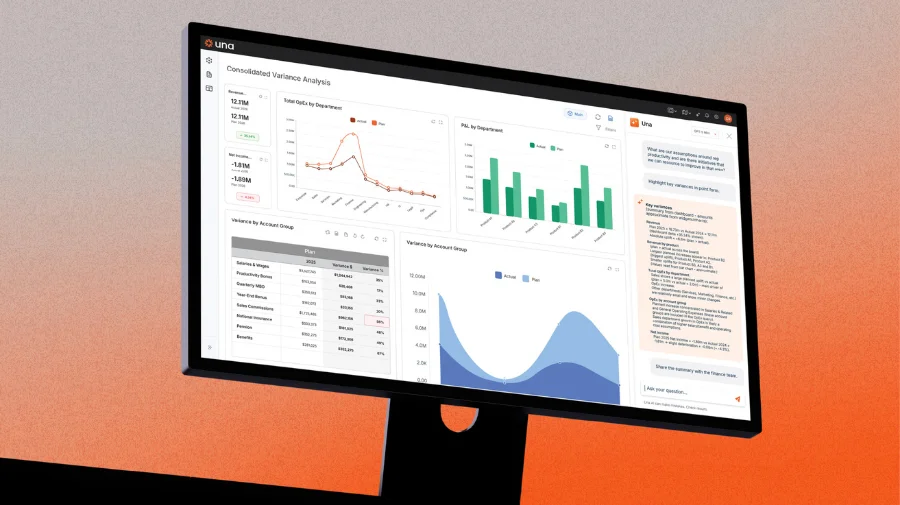
Ready to take control of your budgeting, planning, forecasting and reporting? Schedule a demo and see how Una’s financial planning & analysis software can work for you.
Schedule Demo