The fear that AI would gut finance headcount has not materialized the way most predicted. What has changed instead is who gets hired, and that shift is more consequential than any layoff wave would have been. A 2026 cross-sectional survey of 89 senior finance leaders at mid-market and enterprise companies found just 7% are hiring more because of AI, while 47% are hiring less or slower and 12% of enterprise respondents have already cut headcount. The skills premium has moved decisively toward judgment in AI-augmented workflows, data analytics, and systems integration literacy. Finance is not hiring fewer people because AI replaced them. It is hiring fewer people because the bar for who qualifies has moved, and most candidates have not moved with it.
The Headcount Story Everyone Got Half Right
Gartner's widely cited 2024 prediction, that 90% of finance functions would deploy at least one AI-enabled technology solution by 2026 while fewer than 10% would see headcount reductions, has aged into a more complicated reality. Wolters Kluwer's 2026 research found AI in finance adoption has climbed from 37% of finance professionals in 2023 to 58% in 2024, with 88% of CFOs reporting no headcount reductions tied to AI adoption. That headline still holds broadly true for net job counts.
But a separate Gartner survey of 350 billion-dollar companies actively deploying AI found 80% had already reduced headcount, in some cases by as much as 20%, and the financial returns for companies that cut aggressively were statistically indistinguishable from those that cut modestly or not at all. Layoffs alone did not improve ROI. The distinguishing factor was not whether a company reduced headcount, but whether it redesigned the jobs and skills of the people who remained. Two studies measuring different populations, mid-market versus billion-dollar enterprises, are telling two versions of the same underlying truth: raw headcount is the wrong metric. What is actually shifting is the composition of who stays and who gets hired next.
Finance Is Hiring Orchestrators, Not Operators
The specific skills commanding a premium are not what most finance professionals assume. The 89-leader survey found the shift is toward judgment in AI-augmented workflows, not toward technical AI expertise in isolation. Wolters Kluwer's research reinforces this from the employer side: 85% of finance leaders now prioritize AI skills when hiring, with 11% calling them essential, but the qualities they name alongside AI skills are data readiness, structured AI training programs, and platform adoption experience, not coding ability.
This distinction matters because it separates two very different hiring strategies. A finance function chasing AI skills narrowly might prioritize candidates who can write a clever prompt. A finance function that has actually studied where AI creates value is prioritizing candidates who can evaluate whether an AI output is directionally correct, who understand how the underlying data connects across systems, and who can translate a model's recommendation into a decision a CEO or board will act on. The market is rewarding the second profile at a materially higher rate than the first.
The Real Constraint Was Never the Technology
The 89-leader survey isolates the actual bottleneck with precision. Thirty-three percent of finance leaders cite team capacity as the single biggest barrier to doing more with AI, while just 7% say the right tools do not exist. The constraint is organizational, not technological, and it shows up specifically as data quality gaps, immature processes, and connectivity problems between systems that were never designed to talk to each other.
That organizational gap explains why so much AI investment in finance is not converting into measurable returns. Gartner research covering more than 300 finance executives found that four out of five CFOs are freezing or reducing headcount while simultaneously increasing AI spending, even though more than 90% of generative AI proof-of-concept projects in finance departments have failed to generate incremental value. Teams are cutting the people who might have caught that failure early and funding technology bets that, by Gartner's own estimate, mostly are not working yet. That is a governance and sequencing failure, not proof that AI itself underdelivers.
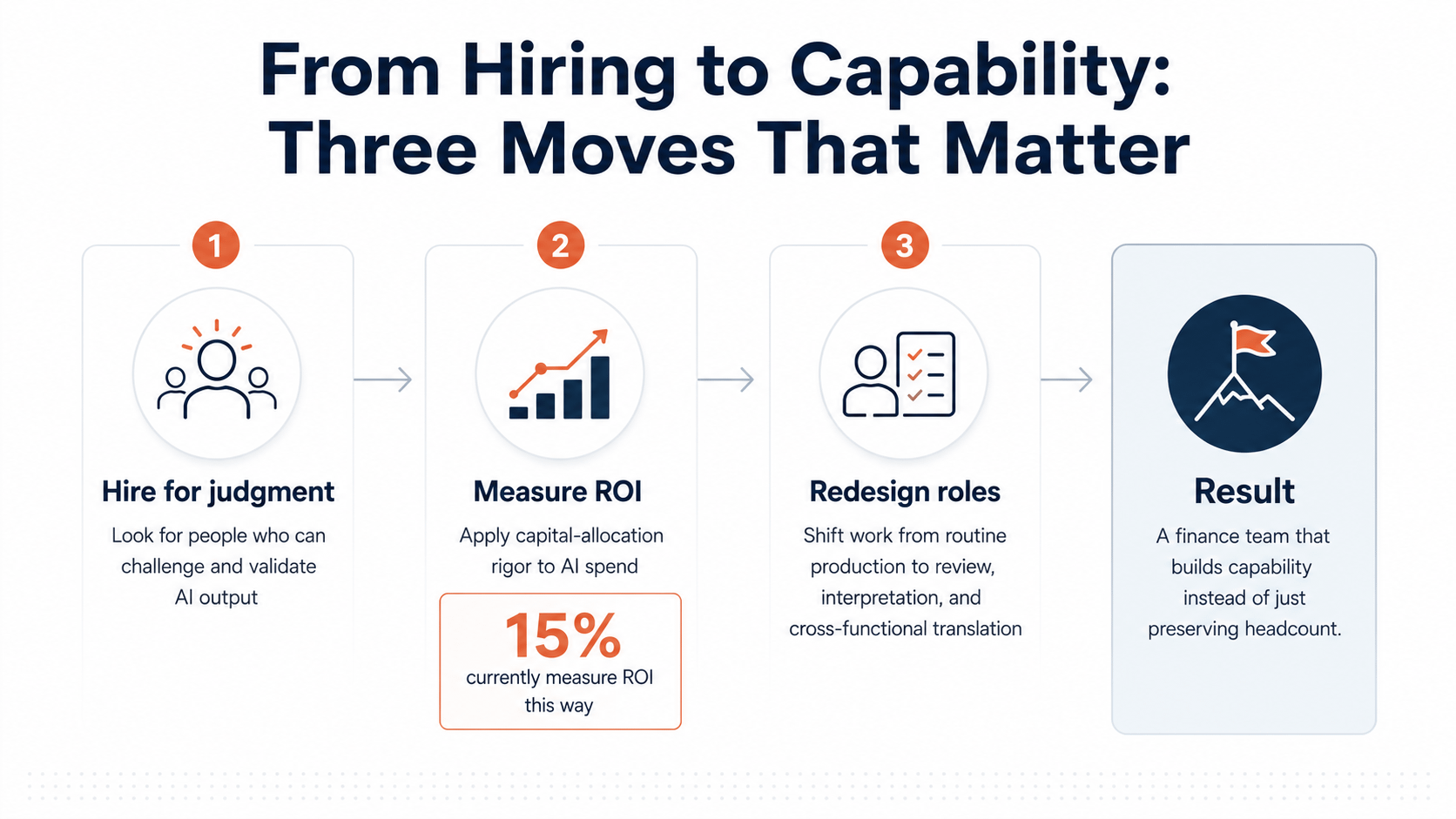
The same 89-leader study found 65% of finance teams plan to increase AI spend over the next 12 to 18 months, but only 15% formally measure ROI. A function that runs on measurement for every other capital decision is, for now, largely taking AI spend on faith. That gap between spending confidence and measurement discipline is precisely where the skills premium is concentrating: finance leaders are searching for people who can build the measurement discipline that is currently missing.
What This Means for How You Hire and Develop Talent Right Now
Three specific moves separate finance functions building durable capability from those quietly eroding it while headcount numbers look stable on paper.
The Test to Run Before Your Next Finance Hire
Ask what percentage of your last five finance hires were screened explicitly for the ability to evaluate an AI output critically, versus the ability to use an AI tool competently. If the honest answer is closer to zero than five, the hiring bar in your organization has not actually moved yet, no matter what the job description says.
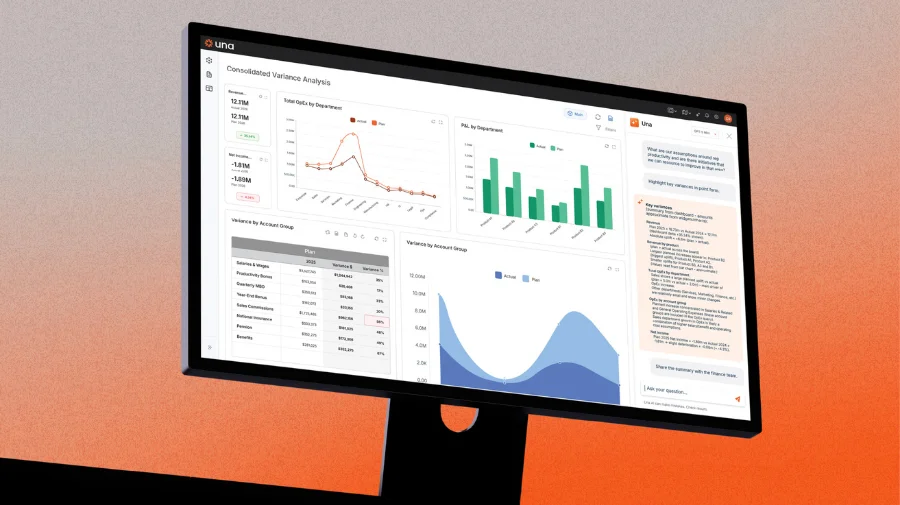
Ready to take control of your budgeting, planning, forecasting and reporting? Schedule a demo and see how Una’s financial planning & analysis software can work for you.
Schedule Demo