While 92% of finance teams have implemented or plan to implement AI this year, only 21% report any measurable ROI. The gap between adoption and actual value comes down to readiness. Elite finance leaders are not just buying tools; they are assessing their team's maturity across six specific dimensions—from data foundation to strategic vision—before spending a dime. Here is the complete framework to benchmark your AI readiness and build a roadmap that actually works.
The uncomfortable truth about AI in finance right now is that we are in the middle of a massive hype cycle that is burning through budgets with very little to show for it. I have spoken with dozens of finance leaders over the past year, and the pattern is remarkably consistent. They feel the pressure from the board to "do something with AI." They buy a shiny new tool or spin up an internal project. Six months later, their team is still spending 80% of their time manually reconciling data in spreadsheets, and the AI tool is gathering digital dust.
This is not a technology failure. This is a readiness failure. According to a 2026 Deloitte survey, while 63% of finance teams have fully deployed and actively use AI solutions, only 21% report clear, measurable ROI. The Hackett Group projects that finance workloads will rise 3.2% this year while headcount declines by 2.1%. You cannot solve that math problem by throwing random AI tools at an unprepared organization. You solve it by understanding exactly where your team stands today and building a deliberate, sequenced roadmap to get where you need to be.
The AI Adoption Illusion
The core problem finance professionals face today is the illusion of adoption. Buying an enterprise license for an AI tool and calling your team "AI-driven" is like buying a gym membership and calling yourself an athlete. The actual transformation requires foundational work that most organizations try to skip.
When you deploy advanced predictive forecasting models on top of fragmented, messy data, you do not get better forecasts. You get highly confident wrong answers delivered at machine speed. When you give powerful generative AI capabilities to a team that lacks basic data literacy and prompt engineering skills, you do not get efficiency. You get frustration and increased risk. BDO found in 2025 that while 92% of finance teams have implemented AI or plan to within 12 months, only 43% have a formal governance framework in place. That is a staggering gap between ambition and infrastructure.
The companies that are actually seeing 30-50% improvements in forecast accuracy and massive reductions in cycle times are the ones that did the unglamorous work of assessing their readiness first. They mapped their data architecture. They evaluated their team's skill levels. They identified which processes were ready for AI augmentation and which needed to be fixed at a foundational level before any machine learning model could add value.
The 6 Dimensions of AI Readiness
After analyzing the transformation journeys of highly successful finance organizations, a clear framework emerges. True AI readiness is not a single metric. It is a composite of six distinct dimensions that must be evaluated and developed in parallel.
Data Foundation is the bedrock. This evaluates how well your current data infrastructure supports AI-powered analysis. If your financial planning data lives across twelve disconnected systems and requires days of manual reconciliation, your data foundation is weak. AI requires a Single Source of Truth to function effectively.
Planning Maturity measures your forecasting and scenario planning sophistication. Are you still running annual budgets with quarterly updates, or have you moved toward continuous, dynamic forecasting? AI models thrive on continuous data feeds and struggle with static, episodic inputs.
Process Automation looks at your current baseline. This assesses the automation level in your close, reporting, and variance analysis. If your team is still manually copying and pasting numbers between systems to close the books, you need to automate those foundational processes before introducing advanced AI capabilities.
Team AI Skills is often the most overlooked dimension. The biggest barrier to technology adoption is a lack of human capital and skills. This dimension evaluates your team's readiness to adopt and leverage AI tools effectively. It is not about turning FP&A analysts into data scientists; it is about developing fluency in interacting with AI systems and interpreting their outputs critically.
Analytics Depth examines how advanced your reporting capabilities are today. Are you entirely focused on descriptive analytics (what happened), or have you begun incorporating predictive (what will happen) and prescriptive (what should we do) analytics? AI delivers the most value when applied to the latter two categories.
Strategic Vision assesses whether your organization has a clear AI strategy specifically for finance. This means having defined use cases, governance frameworks, and clear ROI expectations rather than just a generalized mandate to use new technology.
Take the assessment here and find out how you score and get recommendations on how to get to the next level.
https://benchmark.una.ai/
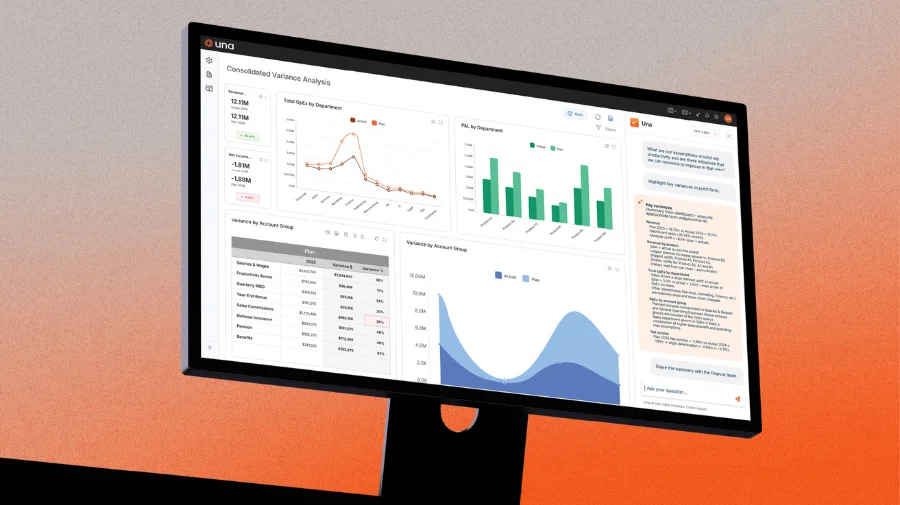
Ready to take control of your budgeting, planning, forecasting and reporting? Schedule a demo and see how Una’s financial planning & analysis software can work for you.
Schedule Demo