AI does not shave headcount evenly across your finance team. It collapses the bottom of the pyramid, hollows out the middle, and raises the bar at the top. The org chart most CFOs are running was designed to move data from junior hands upward. When the data moves itself, the boxes that existed to relay it have no reason to exist. Below is a role-by-role map of what changes, what survives, and the two roles nobody has on their org chart yet that decide whether any of this works.
The Uncomfortable Part First
Most finance leaders are using AI to make the existing org chart faster. That is the expensive mistake. You are paying to accelerate a structure built around a constraint that no longer binds. The old pyramid had a logic. Junior analysts pulled and cleaned data. Senior analysts shaped it into analysis. Managers reviewed it. Directors packaged it for the CFO. Every layer existed because the layer below could not be trusted to hand up something finished, and because moving information through a finance org was slow, manual, and error-prone.
AI does not make that pyramid faster. It removes the reason most of the layers exist. If you keep the layers and add the AI on top, you get the worst outcome available: the same coordination cost, plus a new tool, plus analysts who now spend their day checking the machine instead of being replaced by a better structure. Redraw the chart deliberately, or watch it redraw itself badly through attrition and quiet workarounds.
Role by Role: What Actually Changes
The grunt work goes first. Data pulls, reconciliations, the first-pass variance file, the deck refresh. A capable AI workflow does the 80 percent in minutes.
The lazy conclusion is that you stop hiring juniors. That is how you starve your own pipeline and have no senior analysts in four years. The better move is to change what the junior role is for on day one. Stop hiring people to be human ETL. Start hiring people to interrogate output, build the checks, and own a question end to end with AI as their first analyst.
Pro move: rewrite the junior job description around verification and curiosity, not production. The skill that matters is detecting when a clean-looking number is wrong. That skill used to take three years of doing the grunt work to develop. Your new problem is teaching judgment without the apprenticeship that used to build it. Solve that explicitly or you will have confident juniors who cannot smell a bad number.
This role survives and gets more valuable, but the work inverts. The job shifts from building the analysis to deciding which analysis is worth building and pressure-testing what the model produced. The senior analyst becomes the person who turns a business question into the right analytical structure and catches the place where the AI confidently anchored on a wrong assumption.
The risk is real. A senior analyst who reviews machine output all day, every day, drifts into rubber-stamping. Vigilance decays when the output is usually right. Build the role so they are still constructing something, not only approving.
Half of what an FP&A manager did was logistics. Chase the inputs, consolidate the submissions, reconcile the versions, manage the timeline. When inputs flow continuously from connected systems, the coordination tax drops toward zero.
What is left is the part that was always the actual job: business partnering, scenario design, and the judgment calls inside the model. Managers who defined their value by running the process feel exposed. Managers who defined it by improving the decision get more room to do it.
Here is the counterintuitive one. Automating transaction processing makes the controller more central, because the controller owns whether you can trust the numbers feeding every model upstream. When analysis is cheap and instant, data integrity and controls become the scarce input. The controller who used to be seen as the brakes becomes the person who makes the speed safe.
Your most AI-skeptical controller is often right about the specific risk they are flagging, even when they are wrong about the technology. Promote that skepticism into a defined control function instead of treating it as resistance.
The CFO role moves up the abstraction ladder. The work becomes deciding which questions the firm should be asking, where to deploy human judgment, and which AI-produced numbers get to influence a real decision. The CFOs who struggle are the ones whose identity was being the smartest analyst in the room. The ones who thrive treat their job as capital allocation applied to attention and trust.
The Two Roles Missing from Almost Every Finance Org Chart
This is the part most teams have not scoped, and it is where redrawn org charts succeed or fall apart. Put names in these two boxes.
1. The analytics or finance-systems owner. Someone has to own the logic, the definitions, the model behavior, and the data lineage that the whole team now depends on. In most firms this responsibility is smeared across three people part-time, which means it is owned by no one. When the AI produces a wrong number, you need a named owner of why, not a committee.
2. The output-governance owner. Someone has to own the controls on what AI-generated analysis is allowed to do: what gets reviewed, what gets logged, what can reach the board deck unverified, and what the audit trail looks like. This is a real seat with real authority, not a line in a policy document.
What Nobody Tells You
Where the Redraw Actually Breaks Down
A redrawn org chart assumes the roles can rely on a number without re-deriving it. They cannot, if the data still lives in fourteen disconnected systems and every model starts with a manual export and a VLOOKUP. You can rename the junior role to verification specialist all you want. If they spend the morning stitching exports together, you changed the title and nothing else.
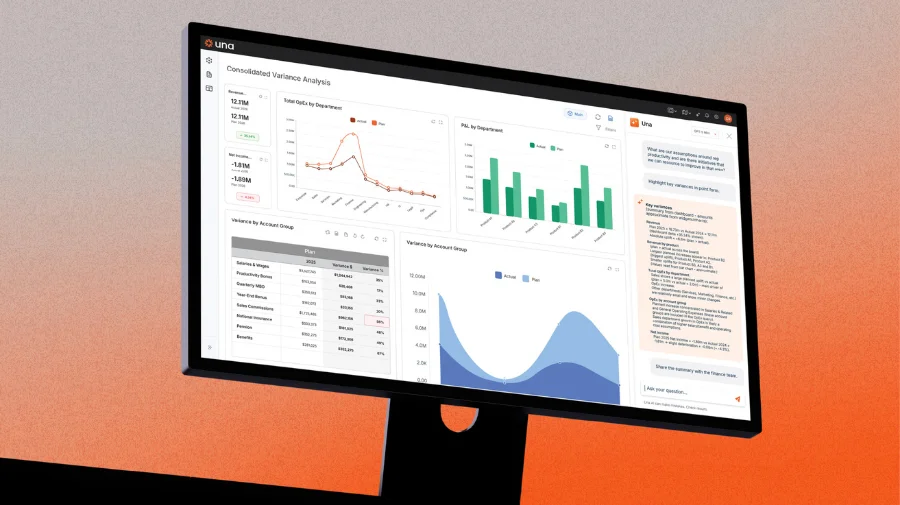
This is the constraint that quietly defeats most finance reorgs. The new roles only exist if revenue, operations, and finance data are unified into one live source the whole team trusts. That is the specific problem Una is built to remove: it unifies your source systems into a single live source of truth, so the analyst is interrogating numbers instead of assembling them, the controller is governing one ledger of definitions instead of reconciling forks, and the manager is partnering instead of chasing inputs. The org chart you want to draw is only viable on top of data that moves itself. Without that foundation, the boxes change names and the work stays exactly where it was.
The Close
The finance org chart is a map of where the constraints used to be. AI moved the constraints. If your boxes still relay data upward through human hands, you are paying senior salaries to staff a relay system the technology already retired.
Redraw it on purpose. Decide what each role is for now, name the two owners you are missing, and treat the structure as something you revisit every two quarters instead of every reorg cycle. If you want to pressure-test the economics before you touch a single box, run the numbers in Una's ROI calculator and see what the redrawn structure is actually worth.
Ready to take control of your budgeting, planning, forecasting and reporting? Schedule a demo and see how Una’s financial planning & analysis software can work for you.
Schedule Demo