Agentic AI is not a copilot with a new name. It is a different operating model. The CFOs winning right now are deploying agents that own end-to-end workflows under human supervision - and redesigning the function around them. Below: the nine highest-ROI agent workflows, the three traps that kill agentic deployments in month three, the controls framework your audit committee will demand, and a 12-month roadmap to get it all done.
If you read nothing else, internalize this: agents do not save hours. They redistribute judgment.
The Strategic Frame
Copilots assist your team. Agents do the work and escalate exceptions. The difference is not semantic — it is structural.
A copilot drafts a variance commentary your analyst still writes. An agent owns the variance commentary, ties it to drivers, surfaces the three variances that matter, and routes the draft to your FP&A lead for sign-off. The analyst is not doing the work. The analyst is supervising the work.
That shift changes how you staff the function, how you define roles, how you measure performance, and how you control risk. CFOs who treat agents like souped-up copilots get incremental gains. CFOs who treat agentic deployment as an operating model redesign get step-change gains.
The Nine Agent Workflows That Earn Their Keep
Ranked by realized ROI across actual finance deployments — defined as hours redistributed multiplied by decision-quality lift.
- The Close Runner An agent that orchestrates the month-end close calendar. Triggers tasks, monitors completion, flags blockers, reconciles sub-ledgers, drafts close memo first drafts. Your controller approves; the agent runs the calendar. Realized lift: close days down 30–60%. Controller time redirected from chasing tasks to reviewing exceptions.
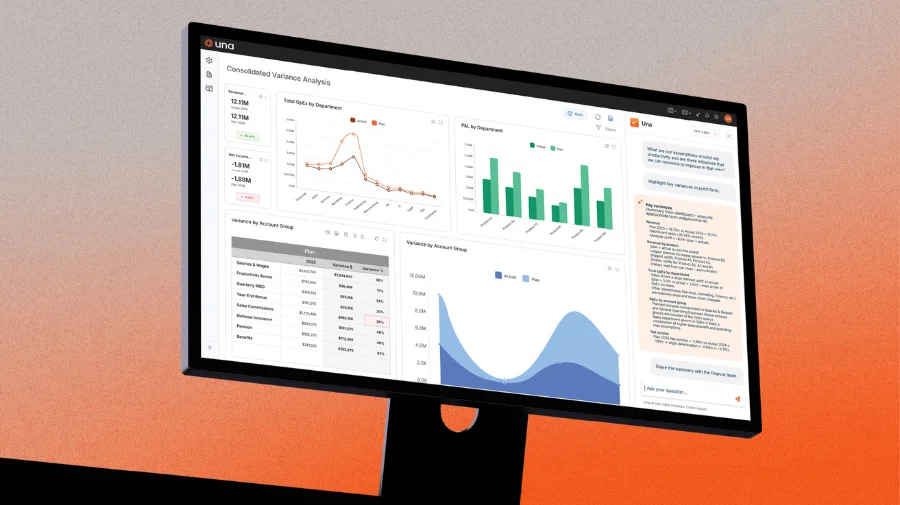
- The Variance Analyst Compares actuals to budget, forecast, and prior period. Generates root-cause commentary tied to drivers. Routes drafts to FP&A leads with the three variances that matter pre-flagged. Realized lift: variance cycle compressed by 70%. Quality of commentary improved because drivers are now mandatory inputs.
- The Forecast Re-Runner Continuous re-forecasting on a weekly cadence, ingesting pipeline, bookings, billing, and operational drivers. Flags material deltas to the prior forecast. Surfaces the assumption changes that drove the delta. Realized lift: forecast accuracy MAPE improved 200–500 bps. Reforecast cycle from quarterly to weekly without adding headcount.
- The Scenario Engine Natural-language scenario requests return a three-statement output with sensitivity bands. Realized lift: scenarios modeled per quarter up 5–10x. CEO and board start thinking in scenarios because the cost of generating one approaches zero.
- The Anomaly Detector Continuous monitoring of GL entries, AP transactions, expense reports, and revenue recognition. Flags outliers in real time. Routes high-severity items to control owners with context attached. Realized lift: material exceptions caught pre-close, not in audit. Auditor reliance on your controls increases — and so does audit fee leverage.
- The Cash Forecaster Daily refresh of a 13-week direct-method cash forecast using AR aging, AP terms, payroll calendars, and historical patterns. Surfaces working-capital risks before they hit the bank balance. Realized lift: 13-week forecast accuracy within 3% rolling. Treasury decisions get faster and tighter.
- The Board Pack Drafter Pulls KPIs, generates first-draft narrative, builds speaker notes, anticipates the three questions the board will ask. Your CFO edits for voice and judgment. Realized lift: board cycle time cut by 50% with higher insight density per slide.
- The FP&A Partner Briefer Pre-reads for every business partner meeting. What moved, why, what is at risk, what to ask about. Your FP&A team walks into every meeting with leverage. Realized lift: business partner satisfaction scores up materially. FP&A becomes a strategic function in perception, not just intent.
- The Audit Prep Agent PBC list management, evidence gathering, tie-out documentation, walkthrough preparation. Your audit lead reviews and signs; the agent does the legwork. Realized lift: audit prep hours cut 40–60%. Audit relationship improves because evidence arrives complete and on time.
The Three Traps That Kill Agentic Deployments
Trap 1 - Autonomy without controls. Someone grants an agent write access to the GL because it speeds things up. The first material misstatement traces back to it. You lose the audit committee. You lose the program. Never give an agent write authority over a financial system without a human-gate workflow and an immutable log.
Trap 2 - The supervision gap. You deploy agents but do not redesign the supervisor role. Senior analysts keep doing the production work out of habit. Agents sit idle or, worse, produce work no one reviews. The fix is operating-model surgery, rewrite the job description, restructure the calendar, retrain the reviewer skill.
Trap 3 - Hallucination tolerance creep. First month, your team verifies every agent output. By month four, they trust it. By month six, a hallucinated number lands in a board pack. The fix is institutional - sampling protocols, red-team reviews, citation requirements, and a culture that treats agent output as a draft, always.
The Controls Framework
The audit committee question is coming. Have this ready before it does
- Inventory. A current registry of every agent deployed in the finance function — purpose, data access, decision rights, owner, last review date.
- Decision rights matrix. What each agent can do unsupervised, what requires human approval, what is prohibited. Documented, versioned, signed.
- Logging. Every agent action logged with input, output, sources, and timestamp. Immutable. Reviewable on demand.
- Model risk management. Periodic review of agent performance, drift, and exception rates. Owner accountable. Findings reported.
- Independence. Internal audit reviews the agent control framework annually. Not the finance team that built it.
- Escalation. Clear path for any control owner to suspend an agent. No bureaucratic friction. Trust requires the kill switch.
Bring this framework to your audit committee before they ask for it. CFOs who lead this conversation control the narrative. CFOs who react to it lose ground they will not recover.
Best Practices
- Build a red team inside FP&A. One person whose job is to break every agent output before it reaches an executive audience. This role pays for itself in month two.
- Run parallel for two quarters. Agent output and human output side by side. Resolve every divergence. This is how you build organizational trust and catch the failure modes the demos do not surface.
- Version-control your agent configurations. Prompts, tools, decision rules — treated like code, reviewed like code, tested like code. Finance teams that skip this rediscover software engineering the hard way.
- Promote your best analysts, do not retire their seats. Agents amplify senior judgment. The leverage point shifts from production to supervision. Your top performers become more valuable, not less.
- Price the stack against your hiring plan, not your software budget. A well-deployed agent is a 0.5 to 1.0 FTE. Compare accordingly. The conversation with the CEO gets easier when framed this way.
- Define accuracy before measuring improvement. MAPE, WAPE, bias, hit-rate — pick the metric that matches the decision. Vanity metrics will get you funded once and fired later.
- Insist on source-level citations on every output. No citation, no deployment. This is the single most effective hallucination control in production.
The 12-Month Roadmap
Months 1–3 — Foundation. Fix the chart of accounts, build the semantic layer, integrate source systems. Do not deploy a single agent yet. This phase is unglamorous and non-negotiable.
Months 3–6 — First agent, end to end. Pick the workflow with the cleanest data and the most pain — usually variance commentary or the close runner. Ship it. Measure the baseline before, measure again after. Build the supervision layer alongside.
Months 6–9 — Adjacent expansion. Add the next two agents. Forecasting and scenarios typically follow variance. Reuse the supervision pattern, the citation standard, the logging framework.
Months 9–12 — Operating model redesign. This is where most CFOs underinvest. Rewrite JDs. Restructure the calendar. Retrain reviewers. Promote the analysts who became great supervisors. Hire fewer juniors. Tell the board.
Takeaway
Agentic AI will not replace your finance team. It will redistribute judgment within it, and the Finance leaders who design the supervision layer correctly will run the most strategic function in the company. Treat this as a tool decision and you will get incremental gains. Treat it as an operating model redesign and you will define the next decade of the finance function. Learn how Una's workflow can help you create your agentic finance team and give your analysts more time for judgement.