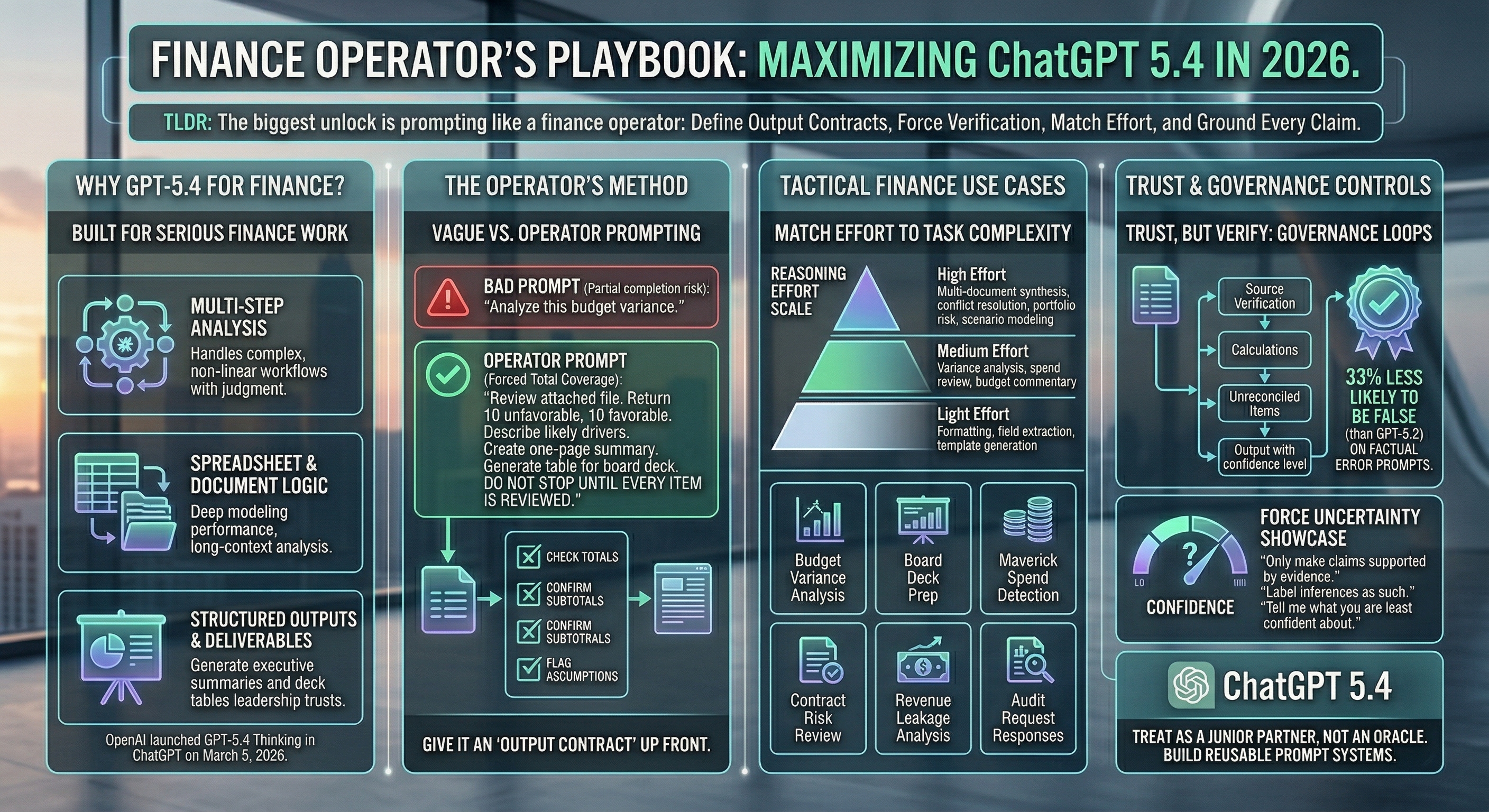
CFOs and finance teams should use GPT-5.4 for the work that usually breaks weaker models: multi-step analysis, long documents, spreadsheet logic, reconciliations, policy review, board prep, and research-heavy decision support. The biggest unlock is not just using GPT-5.4. It is prompting it like a finance operator: define the output, force verification, require completion, ground every claim, and make it show uncertainty instead of faking confidence.
GPT-5.4 is the first ChatGPT model that feels genuinely built for serious finance work. It is much better at multi-step tasks, long-context analysis, structured outputs, spreadsheet-heavy work, and staying on track through complex workflows. OpenAI launched GPT-5.4 Thinking in ChatGPT on March 5, 2026 and specifically highlighted stronger performance on spreadsheet modeling, documents, presentations, factuality, and long-horizon professional work.
For finance, that matters.
Because finance work is almost never one step.
It is:
That chain is where older models often fell apart.
GPT-5.4 is materially better at finishing that chain if you prompt it correctly. OpenAI’s own guidance emphasizes output contracts, verification loops, explicit completion criteria, and matching reasoning effort to the task. That is exactly how finance teams should use it.
Here is the real playbook.
Bad prompt:
Analyze this budget variance
Better prompt:
Review the attached budget vs actuals file and return:
Finance teams lose half the value of AI because they never define the deliverable.
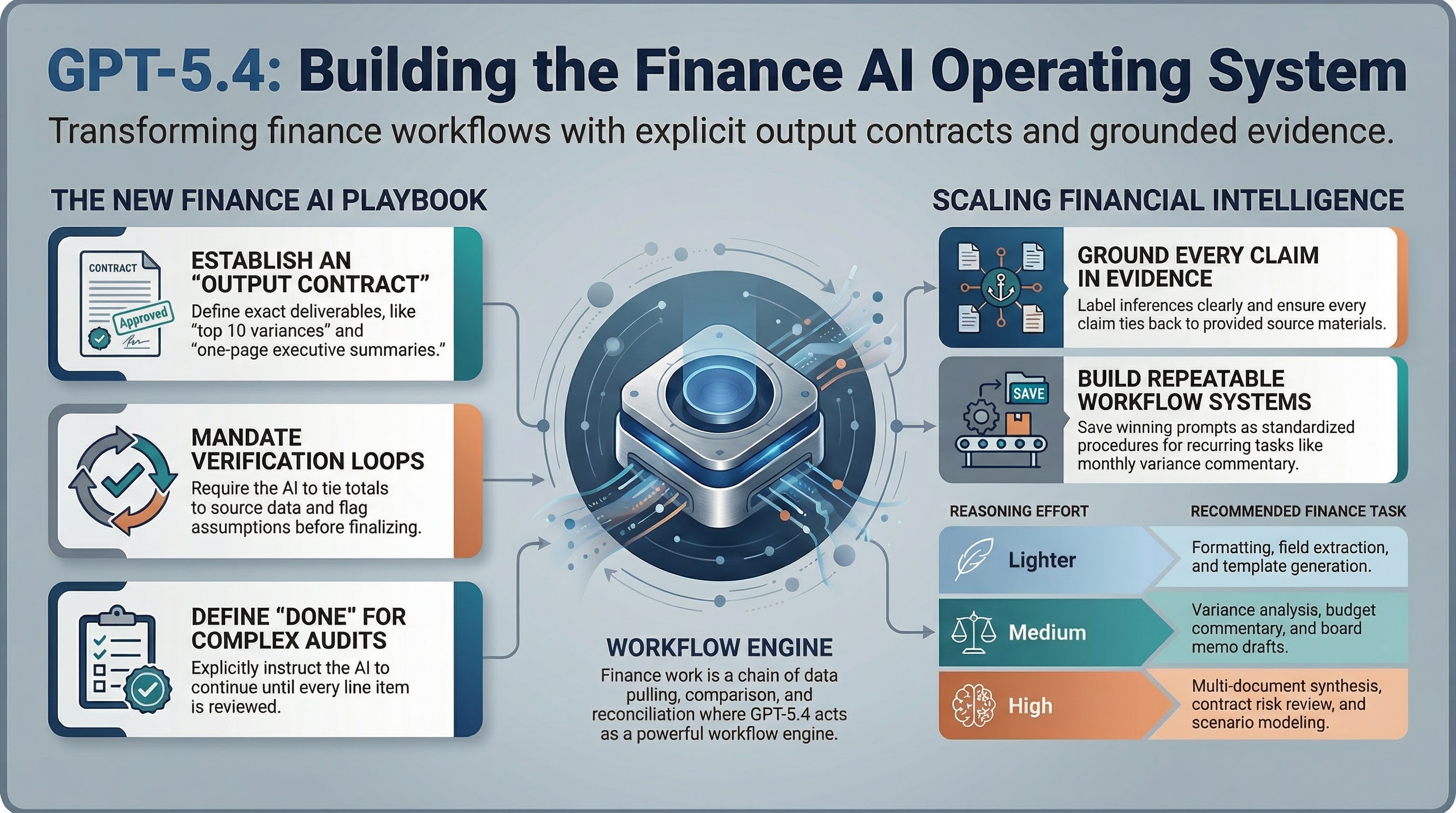
GPT-5.4 works best when you give it an output contract up front. That pattern is straight from OpenAI’s prompt guidance and aligns with the finance workflow in your attached notes.
This is non-negotiable in finance.
Add this to prompts where accuracy matters:
Before finalizing:
Will this eliminate all mistakes? No.
Will it catch a meaningful number of avoidable ones? Yes.
OpenAI explicitly recommends verification loops for GPT-5.4, and finance teams should treat that as standard operating procedure.
One of the most common AI failures in finance is partial completion.
You ask for all contracts.
It reviews some contracts.
You ask for full reconciliation.
It matches the easy lines and quietly quits.
Fix that with one instruction:
Do not stop until every item has been reviewed. If something cannot be resolved, mark it as unresolved, explain why, and continue until the full dataset has been covered.
This sounds simple, but it is a massive unlock for:
The best CFO use cases are not generic brainstorming.
The best ones are high-value, messy, repetitive, judgment-heavy workflows.
Top use cases for finance teams
Why these work:
They combine data, documents, rules, exceptions, and executive communication. That is exactly where GPT-5.4 improved most. OpenAI says GPT-5.4 is stronger on knowledge work, long-context professional tasks, spreadsheet modeling, and polished deliverables.
This is one of the most overlooked best practices.
Not every task deserves maximum reasoning.
Use lighter effort for:
Use medium effort for:
Use high effort for:
OpenAI’s GPT-5.4 guidance explicitly recommends matching reasoning effort to task complexity instead of maxing it out by default.
Finance cannot run on vibes.
Use prompts like this:
Only make claims supported by the files I provided or by cited sources you found. If sources conflict, show both sides. Do not invent citations, numbers, or conclusions. If evidence is weak, say that clearly.
This is especially important for:
GPT-5.4 is more factual than prior versions according to OpenAI, but more factual does not mean trustworthy without controls. OpenAI says GPT-5.4’s individual claims were 33 percent less likely to be false than GPT-5.2 on a set of de-identified factual-error prompts. That is improvement, not permission to stop checking.
This is where finance leaders start getting leverage.
Example workflow prompt:
I need you to complete this workflow in order.
Step 1: Review the vendor spend file and identify all vendors above $50,000
Step 2: Check whether each vendor has a signed contract on file
Step 3: Flag unmatched vendors as possible maverick spend
Step 4: Review contract end dates and notice periods
Step 5: Identify any contract renewal traps in the next 90 days
Step 6: Summarize concentration risk, maverick spend risk, and renewal risk
Step 7: Verify every number against the source files before finalizing
If blocked on any step, explain what is missing and continue with the remaining steps.
That is how finance teams should think about GPT-5.4:
not as a chatbot
but as a workflow engine with judgment
The most expensive AI mistake in finance is false confidence.
Use this instruction:
If you are inferring rather than stating a fact from source material, label it as an inference. If required data is missing, tell me exactly what is missing. Do not fill gaps with confident guesses.
This one instruction can save you from embarrassing mistakes in meetings, deck reviews, and decision memos.
Best practice:
The teams winning with AI in finance are not the teams asking magic questions.
They are the teams building reusable prompt systems.
Do not try to transform all of finance in one week.
Pick one painful recurring workflow:
Then build one serious GPT-5.4 workflow around it.
Run it.
Refine it.
Standardize it.
Reuse it.
That is how AI starts compounding inside a finance function.

Three prompt templates CFOs can steal right now
Review the attached actuals vs budget file and return:
Before finalizing:
Review the attached contracts and return:
Do not stop until every contract has been reviewed. If any contract is unreadable or incomplete, mark it unresolved and explain why.
Using the attached financials, KPI trends, and notes, draft a board update with:
Use a crisp executive tone. Keep it evidence-based. Every claim must tie back to the materials provided. Tell me where evidence is weak.
Bottom line
GPT-5.4 is not interesting because it writes prettier paragraphs.
It is interesting because finance work is structured, multi-step, detail-sensitive, and credibility-dependent.
That is finally a shape of work this model can handle well.
If you are a CFO, VP Finance, controller, FP&A lead, or finance operator, the opportunity is not to use AI casually.
The opportunity is to build a finance operating system around it.
The people who win with GPT-5.4 in finance will not be the ones who ask the cleverest one-off prompt.
They will be the ones who turn recurring financial work into repeatable, verified AI workflows.
That is the shift.
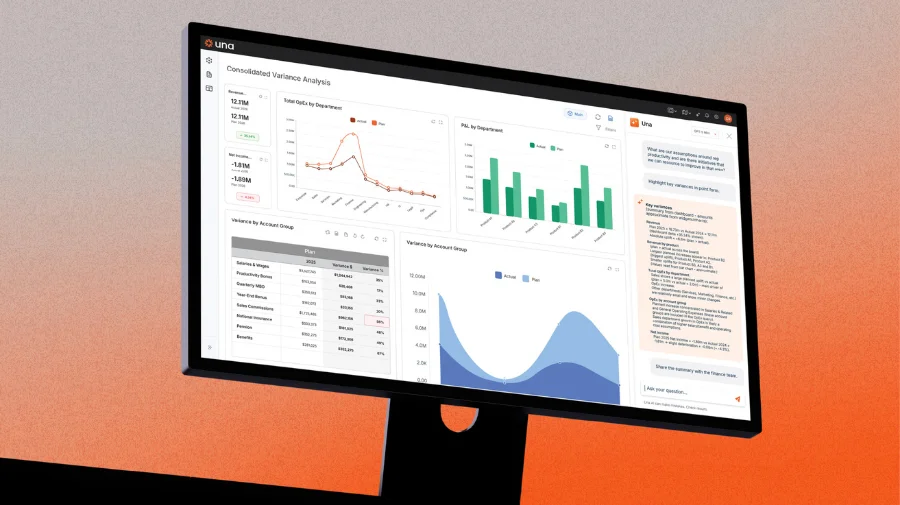
Ready to take control of your budgeting, planning, forecasting and reporting? Schedule a demo and see how Una’s financial planning & analysis software can work for you.
Schedule Demo