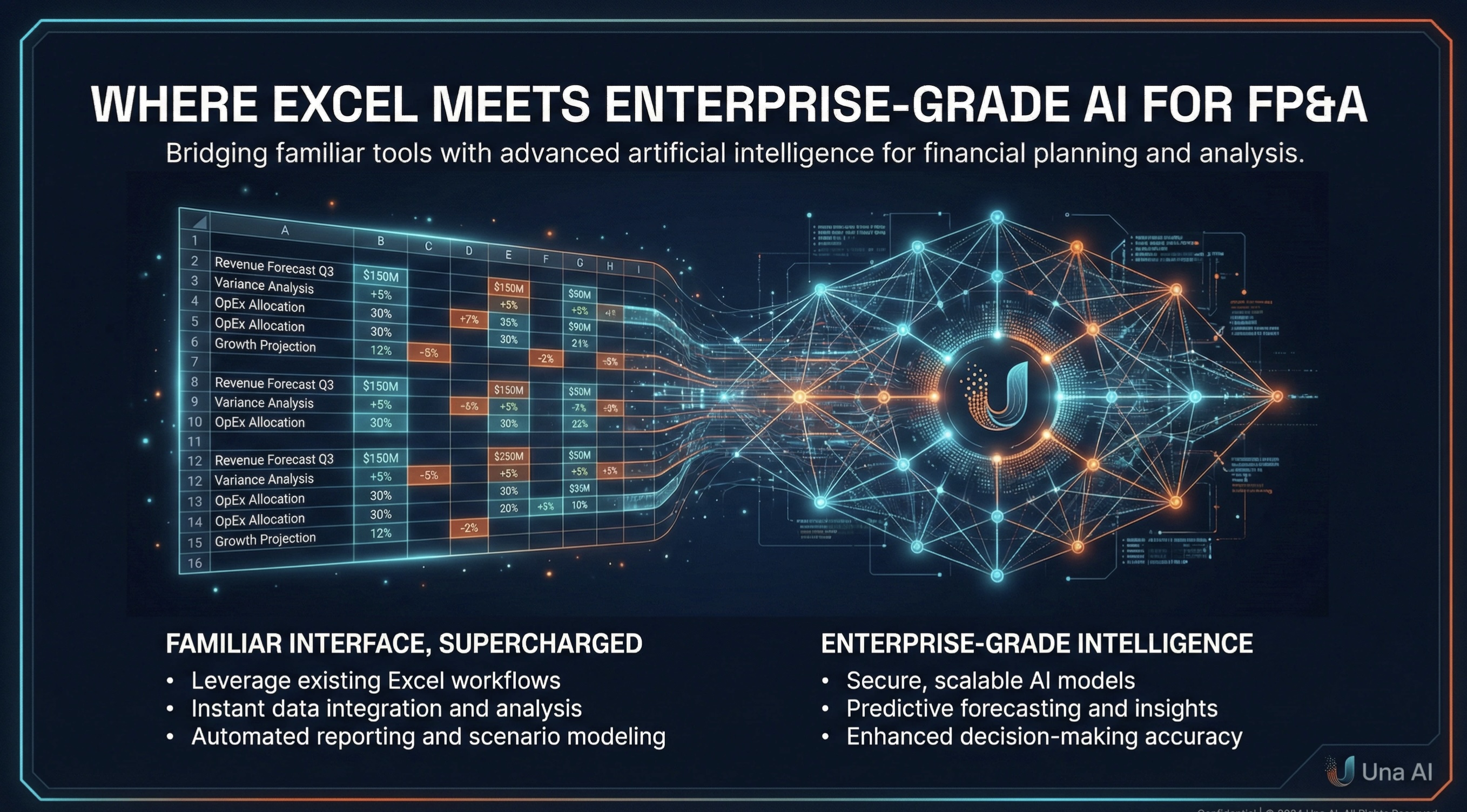
Claude and ChatGPT are transforming how quickly finance teams can generate insight from Excel, but insight without governance creates massive enterprise risk. With eighty-eight percent of spreadsheets already containing errors and sixty percent of employees hiding their use of unsanctioned AI tools, CFOs face a compliance nightmare. Here is the comprehensive guide to bridging the gap between raw AI insight and secure, enterprise-grade execution using unified platforms like Una AI.
The promise of artificial intelligence in finance has always been speed. You drop a messy dataset into Claude or ChatGPT, and within seconds, you receive a perfectly formatted summary, a complex formula, or a variance analysis that would have taken a junior analyst an entire afternoon.
This speed is intoxicating. It is also incredibly dangerous.
As we enter 2026, the debate is no longer about whether finance teams should use AI. Fifty-six percent of finance leaders have already adopted AI tools, double the rate from just three years ago. The new crisis keeping CFOs awake at night is what happens after the AI generates that insight.
Insight without governance creates risk. When an AI agent analyzes your data and suggests a strategic pivot, who approves that decision? How do you know the underlying data was secure? Where is the audit trail?
If your team is simply copying and pasting financial data between Excel and a public AI chatbot, you are not building an AI-powered finance function. You are building a shadow IT infrastructure that threatens the integrity of your entire balance sheet.
The financial cost of ungoverned spreadsheets is well-documented. Academic research from the University of Hawaii indicates that eighty-eight percent of spreadsheets contain errors. In the enterprise world, these are not rounding errors. We all remember the Fidelity Magellan Fund, where the omission of a single minus sign caused a 2.6 billion dollar overstatement.
Now, multiply that risk by the speed of artificial intelligence.
According to recent studies by KPMG and the University of Melbourne, fifty-seven percent of employees admit to hiding their use of AI at work. Even more alarming, BlackFog research shows that sixty percent of employees accept security risks to work faster using unsanctioned AI tools.
When your analysts use ungoverned AI to process financial data, you lose the single source of truth. You lose version control. You lose the ability to defend your numbers to the board or to auditors.
Artificial intelligence alone cannot govern workflows. It cannot control approvals. It cannot secure financial data, and it certainly cannot write decisions back into your core systems to ensure execution actually happens.
AI is how insight gets faster. Governance is how insight becomes impact.
For decades, finance departments have operated under the illusion of control. Because the spreadsheet lived on a secure server or a shared drive, there was an assumption that the data within it was protected. But the reality of modern FP&A is far messier. Models are emailed back and forth. Versions proliferate. Hardcoded plugs are buried deep within nested formulas to force the balance sheet to tie.
When you introduce AI into this fragile ecosystem without a governing framework, you accelerate the degradation of data integrity. An analyst might use an AI tool to quickly generate a complex macro or a dynamic array formula to solve an immediate problem. But what happens when that analyst leaves the company? The model remains, powered by an AI-generated script that no one else understands, completely disconnected from the central data repository.
This is the hidden cost of shadow AI. It is not just about the immediate risk of data leakage; it is about the long-term accumulation of technical debt. Every ungoverned AI intervention adds another layer of complexity to an already fragile system. Over time, the finance function becomes paralyzed by its own tools, unable to trust the numbers it produces.
The solution is not to ban AI, nor is it to force your finance team to abandon Excel. Excel is where finance works. It is the undisputed operating system of the modern analyst. Forcing your team into rigid, unfamiliar web interfaces is a guaranteed path to low adoption and high frustration.
The solution is to bring enterprise-grade AI directly into the environment where your team already operates, wrapped in a layer of absolute governance.
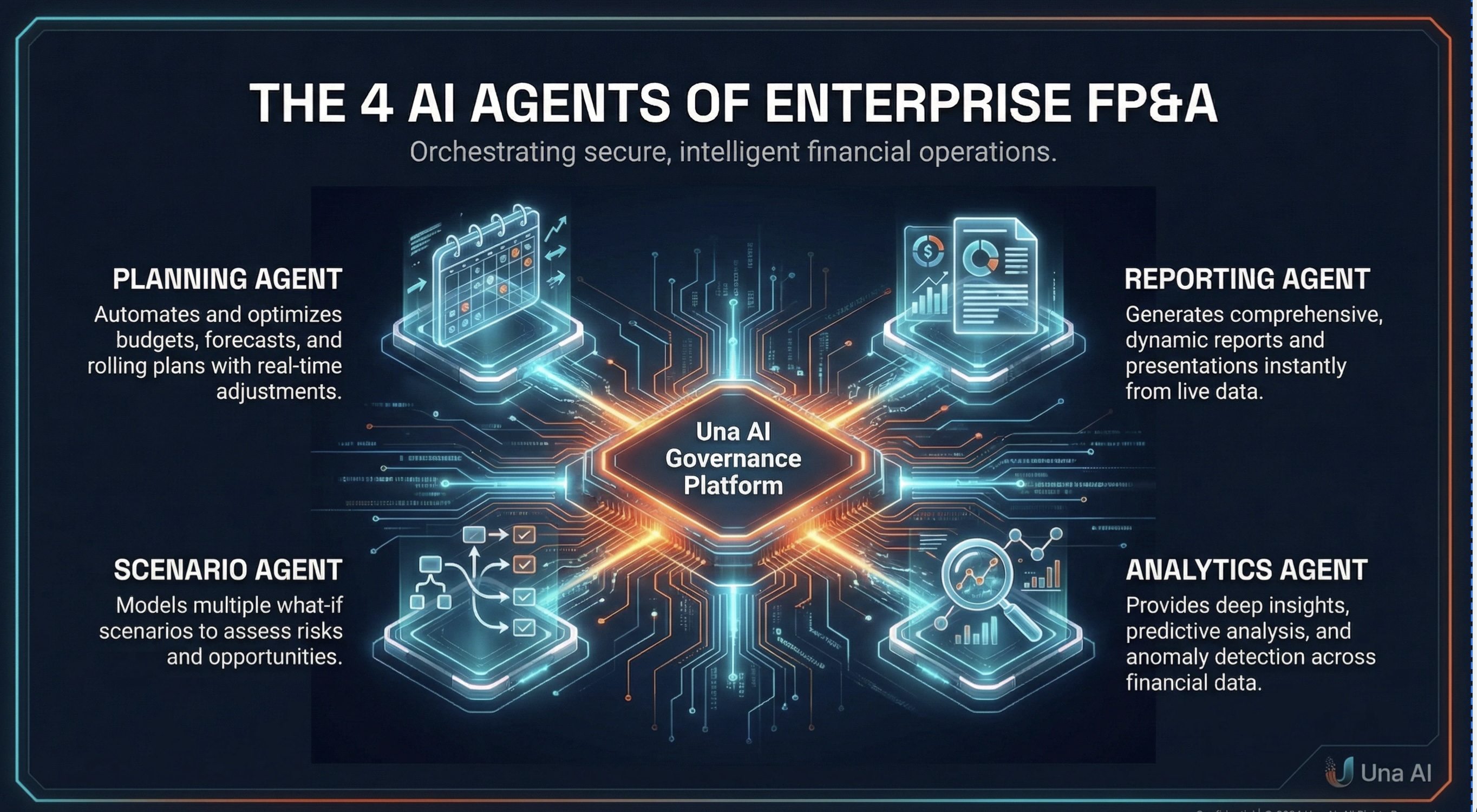
This is the exact architectural philosophy behind platforms like Una AI. Instead of treating AI as an external chatbot, Una embeds intelligent agents directly into the financial workflow. This creates a unified Performance Planning ecosystem where speed and security coexist.
Here is how the modern, governed AI architecture functions in practice:
1. The Planning AgentInstead of manually aggregating dozens of departmental spreadsheets, the Planning Agent orchestrates the data collection process. It identifies anomalies in historical run rates before they are baked into the baseline forecast. Because it operates within a governed platform, every adjustment is logged, versioned, and tied to a specific user.
2. The Reporting AgentWhen the board needs a variance analysis by end of day, the Reporting Agent synthesizes the data across all business units. It generates the narrative commentary explaining the 'why' behind the numbers. Crucially, because it is connected directly to your secure data architecture, there is zero risk of hallucinating numbers or leaking confidential pipeline data to a public language model.
3. The Scenario AgentStrategic agility requires continuous reforecasting. The Scenario Agent allows you to model complex what-if situations—like a sudden supply chain disruption or a shift in pricing strategy—instantly. It automatically recalculates the impact across the entire three-statement model, while maintaining strict access controls so sensitive scenarios remain restricted to authorized leadership.
4. The Analytics AgentThe Analytics Agent serves as your embedded data scientist. It identifies hidden correlations between operational metrics and financial outcomes that a human analyst might miss. But unlike a generic AI, it understands your specific chart of accounts and corporate hierarchy.
The most critical failure point in modern FP&A is the gap between the plan and the execution. You can build the most sophisticated, AI-driven forecast in the world, but if it lives in a disconnected spreadsheet, it is nothing more than a theoretical exercise.
True enterprise AI must close the loop.
When a decision is made based on an AI-generated insight, that decision must be written back into the core systems. Workflows must be triggered. Owners must be assigned. Approvals must be routed through the proper hierarchical channels.
Una AI secures your data, governs your workflows, and turns raw insight into on-time, enterprise execution. It does this while allowing your team to remain inside the Microsoft tools they already know and trust.
If you are leading a finance function today, you have a mandate to deploy AI. But you have an equal mandate to protect the enterprise. Here is the blueprint for achieving both:
Audit Your Current AI ExposureAssume that shadow AI is already operating within your finance team. Conduct a comprehensive audit to understand what tools are being used, what data is being shared, and where the security vulnerabilities exist. You cannot govern what you cannot see.
Establish the Data FoundationAI is a magnifying glass for your data quality. If your underlying data architecture is fragmented across disconnected systems and legacy databases, your AI outputs will be equally fragmented. Prioritize building a single source of truth that connects your CRM, ERP, and HRIS systems into a unified data model.
Deploy Purpose-Built Financial AIStop relying on generic, public language models for sensitive financial analysis. Invest in platforms like Una AI that are purpose-built for Performance Planning. Look for solutions that offer embedded agents, role-based access controls, comprehensive audit trails, and seamless Excel integration.
Focus on Workflow, Not Just OutputDo not measure the success of your AI implementation by how fast it can write a formula. Measure success by how effectively it streamlines the entire financial workflow. Does it automate the approval routing? Does it track execution against the plan? Does it provide defensible, audit-ready documentation?
Upskill the Finance TeamThe transition to governed AI requires a fundamental shift in the skills required of your finance team. You are no longer just looking for analysts who can build complex spreadsheets; you need professionals who understand prompt engineering, model supervision, and strategic storytelling. Invest in training programs that bridge the gap between traditional finance and modern data science.
Create a Culture of AccountabilityGovernance is not just about software; it is about culture. Establish clear policies regarding the acceptable use of AI within the finance function. Ensure that every team member understands the risks associated with shadow AI and the importance of maintaining data integrity. When everyone is aligned on the critical nature of governance, the technology becomes an enabler rather than a liability.
The era of the ungoverned spreadsheet is over. The future of finance belongs to the teams that can harness the exponential speed of artificial intelligence without sacrificing the rigorous discipline of enterprise governance. The technology to achieve this balance is available today. The only question is whether you will lead the transformation or be left managing the risk.
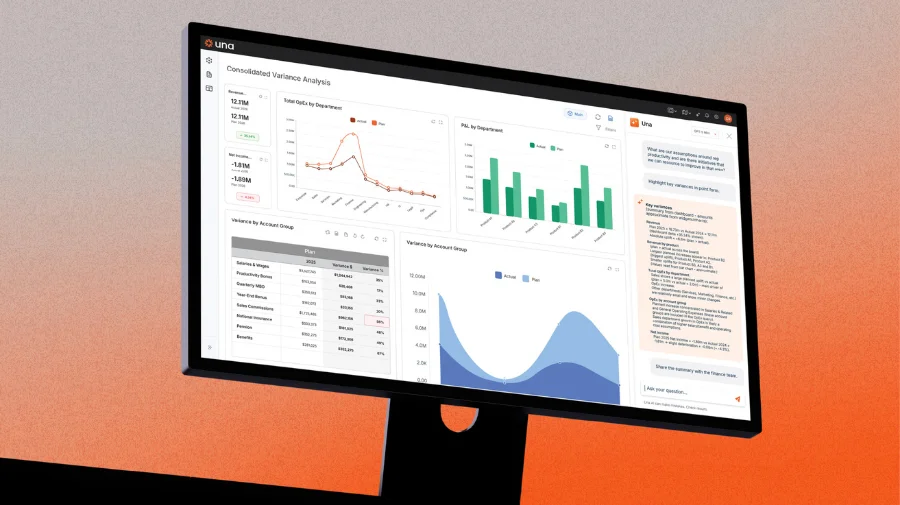
Ready to take control of your budgeting, planning, forecasting and reporting? Schedule a demo and see how Una’s financial planning & analysis software can work for you.
Schedule Demo