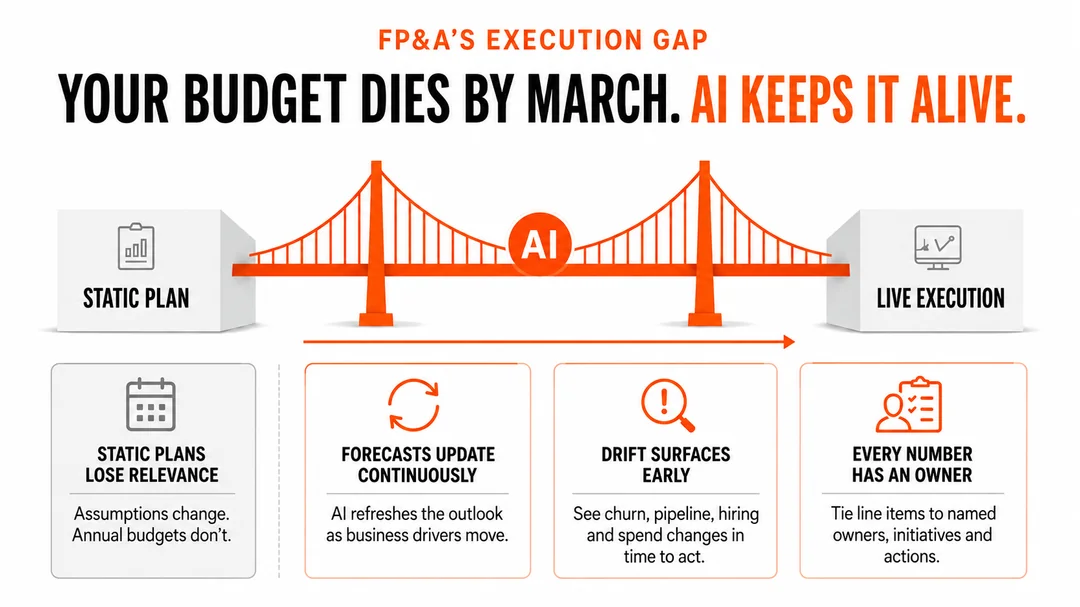
FP&A teams spend months building budgets that the business quietly drops by March. The plan isn't the problem—it's the execution gap. AI helps close it by keeping rolling forecasts current, flagging drift in real time, and tying line items to named owners.
Building the plan gets all the hype. Following it gets zero.
A typical planning cycle: months of data gathering, modeling, and executive reviews. Leadership signs off, the deck looks pristine, and everyone moves on.
Then March hits. Sales shifts priorities, a key hire gets delayed, a vendor bumps pricing—and nobody looks at the budget again. The drift doesn't surface until variance reviews weeks later, long after anyone can actually fix it.
That's the dirty secret of FP&A: success gets measured on model quality, but the business only gains value from execution. They aren't the same thing.
A plan that can't update becomes shelfware.
Plans die the same way every time. Assumptions shift, the model doesn't, and people notice. As soon as a department head realizes the budget no longer reflects operational reality, they stop checking it. It turns into a compliance exercise rather than a decision tool.
This is where continuous forecasting earns its keep. Instead of a static annual model, AI-driven rolling forecasts re-run weekly off live inputs—pipeline movement, headcount actuals, spend run rates—rather than waiting for month-end close. When the numbers stay relevant, teams actually keep using them to make decisions.
Variance analysis is an autopsy, not an early warning.
Traditional variance analysis happens after the fact. The quarter closes, finance digs through actuals, and three weeks later everyone learns what went wrong—long after the window to fix it has passed.
AI-powered anomaly detection flips this into an early warning system. It spots actuals pulling away from plan while it's happening—a churn uptick, a pipeline slowdown, or spend trending hot—in week two of the quarter, not week two of the next one. The conversation shifts from "why did we miss?" to "here's what's drifting, let's correct it now."
A forecast without an owner is just a spectator sport.
Even an accurate forecast falls flat if nobody owns the outcome. Plans usually break in the handoff: approved at the top, abandoned in the middle.
The fix is structural: mapping key line items to named owners with concrete initiatives and tracked progress behind each one. When the forecast calls for slowing down hiring, that becomes an assigned task with a deadline and a responsible person—not a bullet point that evaporates right after the QBR.
The teams winning with AI in FP&A aren't the ones with hyper-complex models—they're the ones closing the loop.
Una AI helps finance teams close the gap between planning and execution with AI-powered rolling forecasts, real-time drift detection, and owner-level accountability.
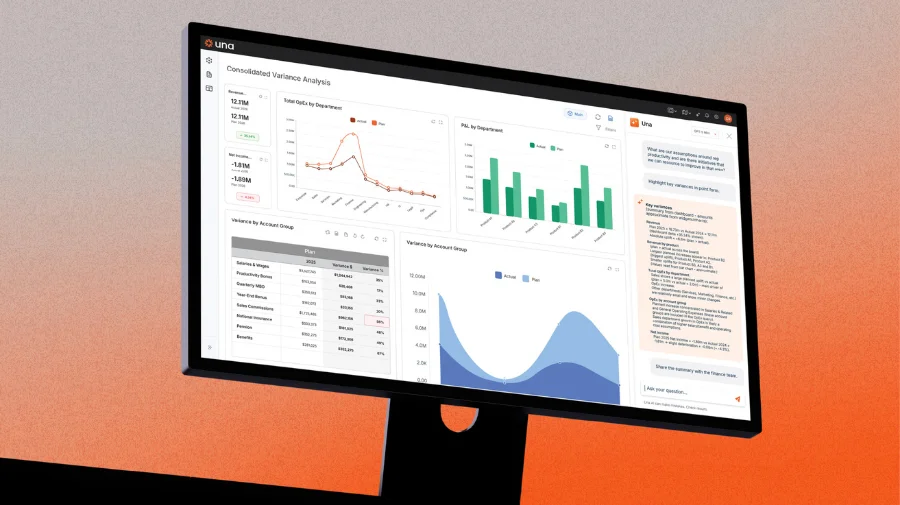
Ready to take control of your budgeting, planning, forecasting and reporting? Schedule a demo and see how Una’s financial planning & analysis software can work for you.
Schedule Demo