The title is the same. The job is not. BCG's 2026 research on the AI-first finance function makes the identity shift explicit: within two to five years, AI agents will execute, monitor, and optimize finance activities in real time — and the CFO's mandate shifts definitively from producer of numbers to architect of value.
This is not a metaphor. It is an organizational redesign brief. And the CFOs who understand what it requires are the ones who will define this era.
What Becomes Autonomous
When BCG and SAP surveyed senior finance leaders in 2026, the emerging picture of the AI-first finance function was specific:
The efficiency impact is not marginal. BCG estimates that the number of staff required to handle today's finance workflows could be cut in half within this transformation window. Oliver Wyman's survey of 494 CFOs representing 12% of global market capitalization found that 91% already expect flat or lower finance headcount, and 64% anticipate a significant shift away from junior roles entirely.
What the CFO Actually Does in This Model
This is where most framing of the future CFO goes wrong, it stays abstract. The BCG research is more precise about what the mandate actually becomes:
The Tradeoffs That AI Finally Breaks
For decades, CFOs have been forced to choose:
BCG's framing is direct: AI breaks these compromises**.** The finance function powered by AI agents can have both accuracy and speed. Deeper insight and lower cost. Tighter control and less friction. The 24/7 control tower model — continuously monitoring performance, automatically detecting deviations, instantly simulating tradeoffs, dynamically reallocating capital — was structurally unavailable before agents. Now it is not.
The Oliver Wyman and NYSE data underscores the mandate shift: only 26% of CFOs now cite financial reporting and data stewardship as among their most important duties**.** Strategy and transformation is the runaway leader, cited by 69–77% of CFOs across every company-size category.
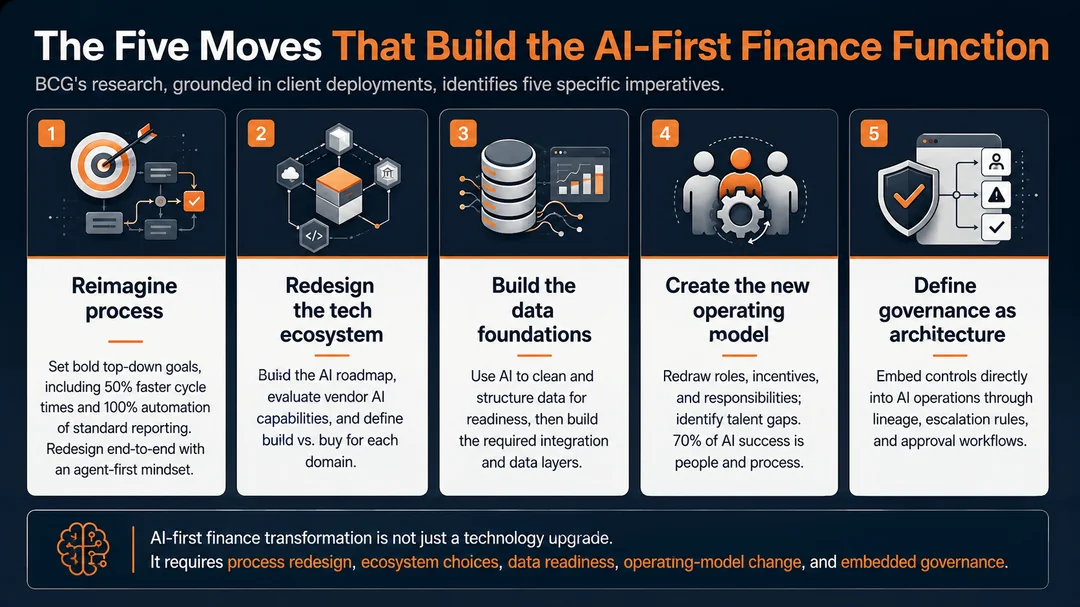
The Five Moves That Build the AI-First Finance Function
BCG's research, grounded in client deployments, identifies five specific imperatives:
MoveWhat It Means in PracticeReimagine processSet bold top-down goals — 50% reduction in cycle time, 100% automation of standard reporting. Redesign end-to-end with an agent-first mindset, not a bolt-on mindset.Redesign the tech ecosystemBuild the AI tech roadmap. Assess current vendor AI capabilities. Define build vs. buy for each domain.Build the data foundationsLeverage AI itself to clean and structure datasets for AI readiness. Build the integration and data layers that priority use cases require.Create the new operating modelRedraw roles, incentives, and responsibilities. Identify talent gaps. A cross-functional AI transformation office may be needed. 70% of AI success is people and process.Define governance as architectureGovernance in finance is not a policy document. It is embedded into how AI operates, data lineage, escalation rules, approval workflows that preserve controls as agents take on more steps.
What This Means for the CFO's Identity
The Oliver Wyman and NYSE research found that CFO-to-CEO promotions reached a 10-year high in early 2026, with 1 in every 10 new CEO appointments at Fortune 500 and S&P 500 companies coming directly from the CFO seat. The skills that define this transition are exactly the skills that AI amplifies rather than replaces.
The finance function that emerges from this transition resembles less a reporting organization and more a 24/7 enterprise control tower: continuously sensing performance, automatically detecting deviation, instantly simulating tradeoffs, dynamically reallocating capital, and proactively engaging the business before it asks.
The CFOs who build this capability first will not just cut costs and accelerate reporting. They will rewire how their organizations sense, decide, and act. In a world where every competitor has access to the same AI tools, the advantage goes to those who embed intelligence deepest into the fabric of how the enterprise runs. That is what it means to be an architect of value.
Where Una AI Fits
The five moves BCG identifies all converge on one prerequisite: a unified data and planning foundation that AI can operate on. That is not achievable when revenue data lives in the CRM, operational data lives in ERP, and finance lives in spreadsheets.
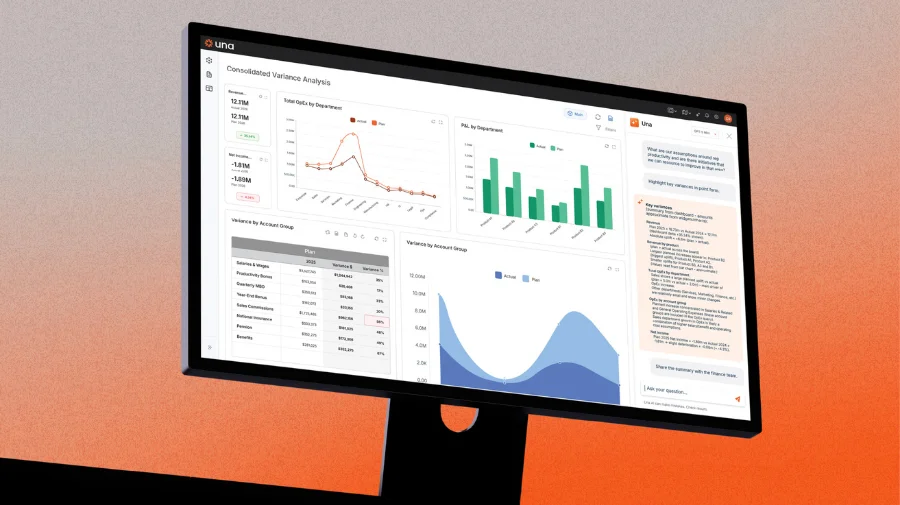
Una AI was built specifically for this transition, an AI-native platform that unifies revenue, operations, and finance into a single connected model. When AI generates a forecast, a scenario, or a variance explanation in Una, it is reasoning across the full picture of the business, not a partial extract. That is the architecture that makes the CFO's new role (continuous reforecasting, real-time capital reallocation, agent-assisted planning) operationally real rather than theoretically possible.
If you are mapping the transition from producer of numbers to architect of value, the starting point is understanding where your foundations stand today.
Ready to take control of your budgeting, planning, forecasting and reporting? Schedule a demo and see how Una’s financial planning & analysis software can work for you.
Schedule Demo