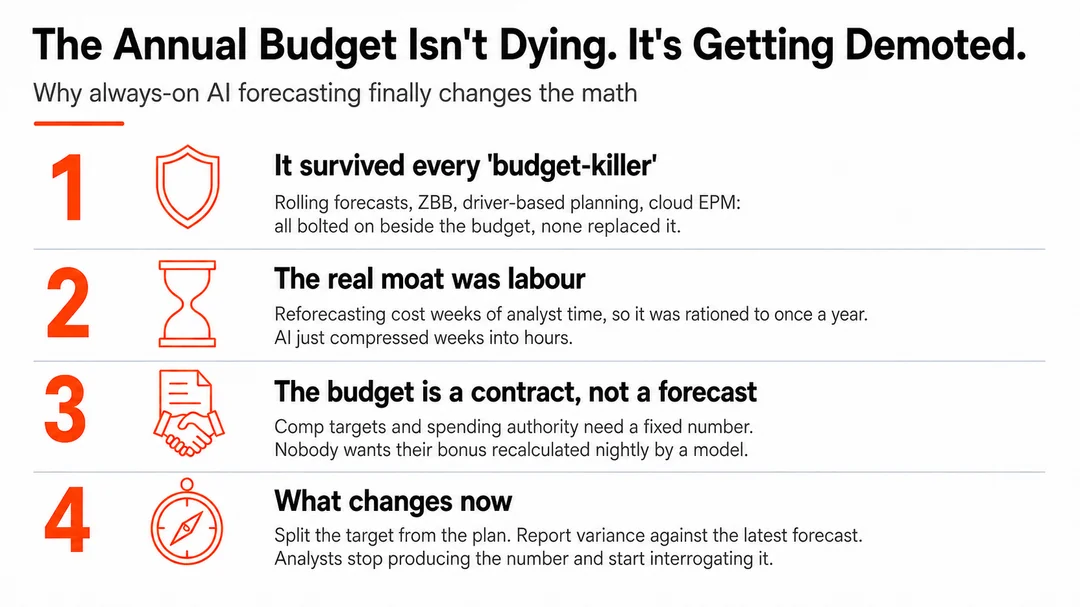
The annual budget survived every tool that promised to kill it because reforecasting was expensive. AI just made it cheap. The budget won't die — it'll get demoted to a comp contract, because nobody wants their bonus target recalculated nightly by a model.
1. The budget has outlived every "budget-killer."
Rolling forecasts. Zero-based budgeting. Driver-based planning. Cloud EPM. Each arrived with a keynote promising the death of the annual budget, and each ended up bolted on beside it. Finance teams ran both for a cycle or two, got exhausted, and quietly went back to the ritual. Any "this time is different" claim owes an explanation for the last three times.
2. Here's why this time might actually be different: the moat was labour, and it just drained.
The annual cycle never existed because once-a-year planning was good. It existed because a full replan cost weeks of analyst time, so reforecasting got rationed like a scarce resource. That's a labour constraint, not a planning philosophy. When an AI-assisted reforecast compresses from weeks to hours — pulling actuals, rerunning drivers, drafting the variance narrative — the scarcity that justified the ritual is gone. The budget's defense was never that it was right. It was that nothing cheaper existed.
3. But the budget was never really a forecast. It's a contract.
This is the part the "budget is dead" crowd keeps missing. Budgets set comp targets, spending authority, and accountability lines. An always-on forecast is genuinely better at predicting — and genuinely terrible at being a fixed reference point people can be held to. Everyone already treats the budget as fiction by Q2 — they just aren't allowed to say it in the deck. So the realistic endgame isn't death, it's demotion: the budget shrinks into a lightweight target-setting exercise done once a year, while the living forecast takes over actual steering.
4. What to do about it now.
Three practical moves: split the target artifact from the planning artifact instead of forcing one spreadsheet to be both a contract and a prediction; start reporting variance against the latest forecast, not just the stale annual number (the stale comparison is where credibility goes to die by Q3); and expect the analyst role to shift from producing the reforecast to interrogating it — the model generates the number, the human argues with it.
Una AI is an AI-native FP&A platform built for continuous planning, forecasting, and execution tracking.
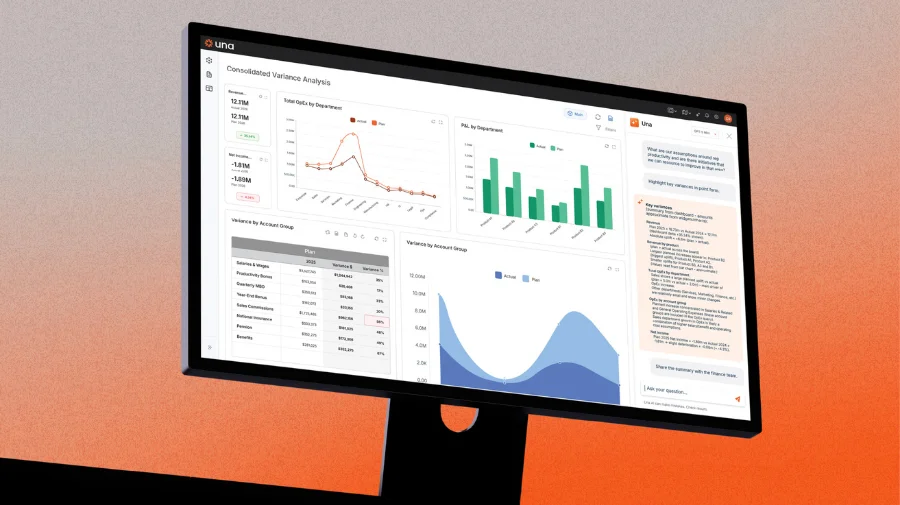
Ready to take control of your budgeting, planning, forecasting and reporting? Schedule a demo and see how Una’s financial planning & analysis software can work for you.
Schedule Demo