AI will not do FP&A for you, but it will expose whether your team is running a reporting function or a decision intelligence function. This post breaks down how to move towards decision intelligence with specific use cases, leading prompting frameworks and other pro tips.
The AI FP&A Playbook: What Elite Finance Teams Are Actually Doing
Most finance teams are using AI to do the same work faster. The best finance teams are using AI to do entirely different work. That gap between AI as an accelerator and AI as a strategic multiplier is where the most important CFO conversation of this decade is happening.
Why Most AI Experiments in Finance Fail
The majority of AI pilots in FP&A stall for three reasons. First, the use case is too narrow. Teams deploy AI to automate a single task, see modest results, and move on without connecting it to the broader intelligence layer. Second, the output goes to no one. AI generated analysis that does not change a decision is just faster noise. Third, the prompting is generic. Finance professionals who get the most out of AI treat it like a highly capable analyst who needs context, constraints, and a clearly defined job.
The Use Cases Where AI Makes a Strategic Impact
Not all use cases are created equal. These are the ones with the highest signal to effort ratio based on what leading finance teams are deploying today.
Rolling Forecast Acceleration The traditional quarterly reforecast is dead. The best finance teams now run continuous rolling forecasts, and AI makes that operationally viable. AI compresses the time it takes to update assumptions, model scenarios, and generate variance bridges.
Pro tip: Train your team to prompt AI with current actuals, prior forecast, and the question "what are the three most likely explanations for this variance, given these business drivers?"
Scenario Planning at Speed Where it used to take days to model five scenarios with full P&L sensitivity, AI can generate the analytical skeleton in hours. The CFO's job shifts from building the model to interrogating its assumptions.
Pro tip: Ask AI to generate scenarios and then explicitly ask it to challenge each scenario's core assumption. This builds intellectual pressure into your planning process.
Board and Management Narrative Generation The cognitive load of translating financial data into executive narrative is enormous. AI, when given the right context, produces first draft management commentary that is highly usable. The CFO's edit becomes about sharpening the strategic framing.
Pro tip: Prompt AI to "write management commentary for a board audience explaining the three most important financial developments this quarter, their strategic implications, and what decisions they should inform."
The Prompting Framework That Works
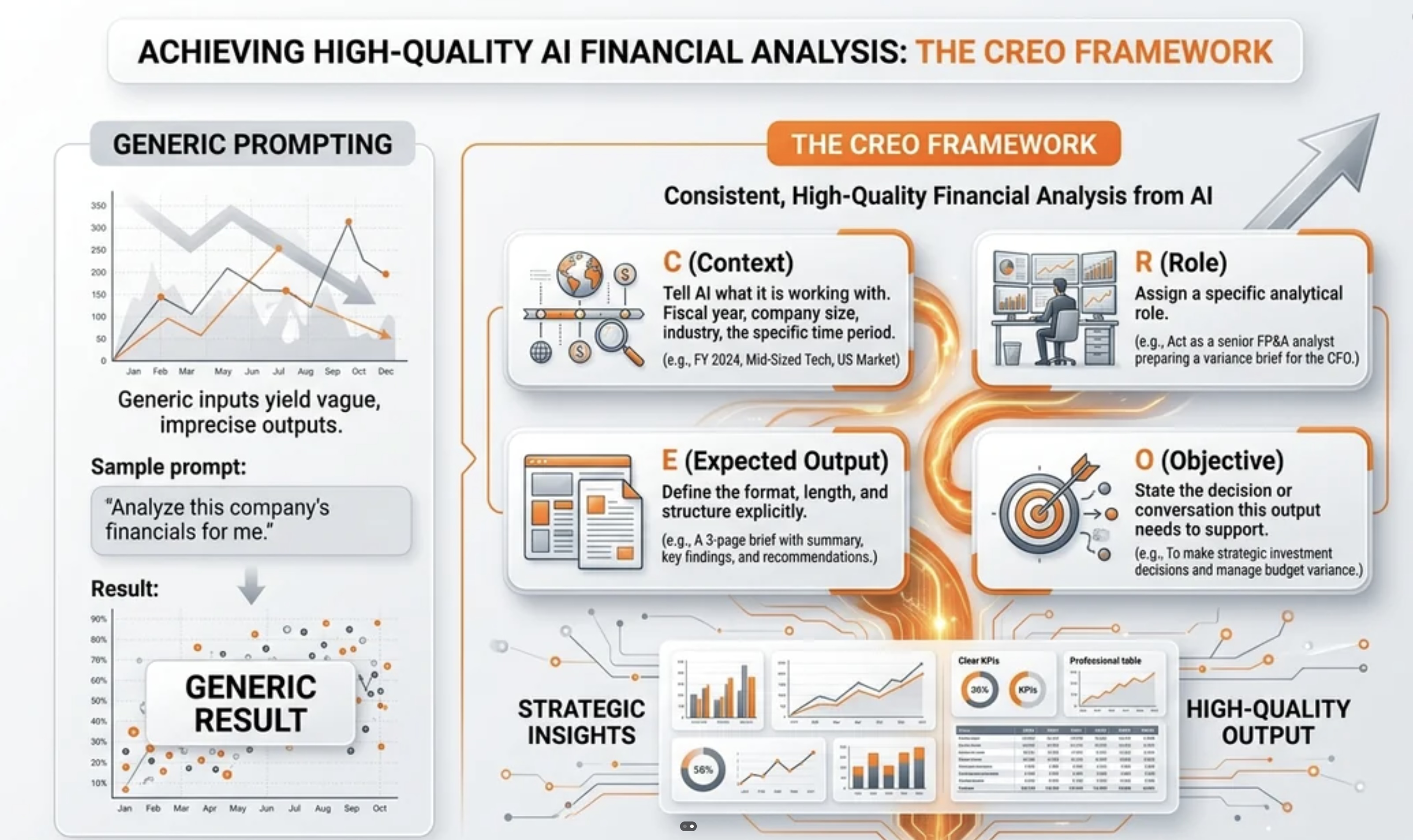
Generic prompting gets generic results. The CREO Framework consistently produces high quality financial analysis from AI.
The Honest Assessment
AI will not make a weak FP&A function strong. It will make a strong FP&A function faster, deeper, and more strategic. If your team is still primarily focused on reporting the past rather than informing the future, AI is not your core problem, your operating model is. Fix that first, then layer AI on top.
The finance leaders who will be most valuable in five years are not the ones who understand AI best. They are the ones who used AI to free up the capacity to do the strategic work that AI cannot do: judgment, relationships, and the courage to tell the truth about what the numbers mean. Start building that capacity today.
Ready to take control of your budgeting, planning, forecasting and reporting? Schedule a demo and see how Una’s financial planning & analysis software can work for you.
Schedule Demo