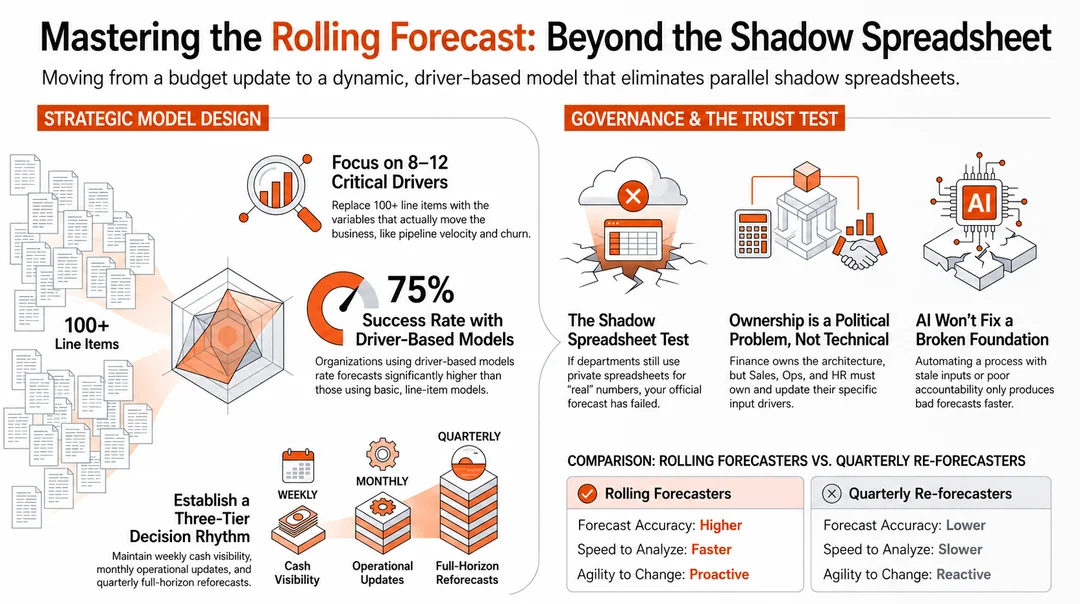
Most rolling forecasts fail before AI ever enters the picture. The model rolls too many line items instead of the 8-12 drivers that actually move the business. AI accelerates the feedback loop but does not fix broken cadence, broken ownership, or the shadow spreadsheet still living in someone’s Downloads folder. The test is simple: if a parallel model still exists somewhere in the building, the rolling forecast has not replaced anything.
Most $100M businesses have a rolling forecast.
But not always one that actually works.
That is the problem. Because a business can have a rolling forecast on the slide deck, a cadence on the calendar, an AI tool in the stack, and yet the finance team is still one conversation behind reality every single month.
The forecast rolls in name only. The drivers are a list of 140 line items nobody actually updates. And when AI enters the picture, all it does is make the broken process faster.
That is why I put together this breakdown. It covers the four things that separate a rolling forecast that actually works from one that just exists.
When you get these four things right, you stop reacting to what already happened and start driving what comes next.
1. You Are Rolling Too Many Things
A forecast answers one question: given what we know right now, what is the business likely to do? You do not need 140 line items to answer it. You need the 8 to 12 variables that, when they move, make everything else move.
In a $100M business that list tends to include pipeline velocity and conversion rate, average contract value or unit economics, gross margin by product line, headcount hiring timing, churn or retention rate, and one or two key variable cost drivers. Everything else is an output. The moment you roll outputs as if they are inputs, you have built a very elaborate budget update, not a forecast.
According to an FP&A Trends Survey cited by Centage, roughly three quarters of organizations using dynamic, driver-based models rate their forecasts as good or great, versus around one quarter with basic models. That gap is not about technology. It is about model design.
AI can identify historically predictive variables and automate actual ingestion in near real-time. What it cannot do is tell you which 10 drivers to build around. That is a business judgment you make before the AI has anything useful to work with.
2. The Cadence Has Not Changed
People talk about rolling forecasts as if AI unlocks a new update frequency, a continuous, always-live model. That is theoretically possible. It is operationally useless in almost every $100M business, because the constraint has never been model speed. It has been decision rhythm.
A $100M business still needs three things. Weekly cash visibility through a 13-week rolling cash forecast. Monthly operational updates so department heads know whether they are tracking to plan. And quarterly full re-forecasts where the horizon extends, assumptions get stress-tested, and the board narrative gets refreshed.
FSN's research across 500+ finance organizations found that rolling forecasters outperform quarterly re-forecasters in every category: speed, accuracy, and agility to respond to change. The differentiator was not model update frequency. It was having the analysis done before the meeting started.
What AI changes is how much work is done between checkpoints; actuals ingested same-day, variance commentary drafted before the management meeting, scenarios pre-built rather than live-modeled. The cadence itself does not change.
3. Ownership Is Still the Hardest Part
Month four of most rolling forecast implementations looks like this: finance has a beautiful model, the cadence is set, the tool is live, and the forecast is wrong. Not because the model is wrong, but because the inputs are stale. Sales has not updated the pipeline. Ops has not flagged the new vendor contract adding $400K to COGS next quarter.
No AI tool fixes a political problem. Finance owns the model architecture. Sales owns pipeline assumptions. Ops owns cost and capacity. HR owns headcount timing. The governance question most implementations skip is what happens when an assumption owner does not update their inputs. If there is no consequence and no visibility, it will not get updated, because updating the forecast is not in anyone's job description except finance, and finance does not control the inputs.
Gartner's 2025 AI in Finance Survey found 59% of finance functions are using AI, but the top use cases are knowledge management and AP automation. Automating assumption ingestion before solving ownership accountability just makes it faster to produce a forecast built on stale inputs.
Answer three questions before any AI deployment. Who is the named owner for each driver? What is the update protocol? What is the escalation path when an assumption goes stale?
4. The Shadow Spreadsheet Test
This is the only diagnostic that matters. Walk through every department that interacts with the forecast and ask one question: does anyone here have their own model (a spreadsheet, a shared Google Sheet, a dashboard they built) that they trust more than the official forecast?
If the answer is yes, the rolling forecast has not replaced anything. It has added a layer on top of the models that were already there.
Shadow spreadsheets persist because the official model does not update fast enough, does not show the right level of detail, does not answer the question the department head is actually asking, or is not trusted because the assumptions feel like someone else's assumptions. None of those root causes are solved by adding AI to the existing process. They require changing the process.
Where AI genuinely changes this dynamic: if the official model updates in near real-time, shows business-unit-specific cuts, and answers ad hoc questions through natural language, the reasons to maintain a shadow spreadsheet start to disappear. But only if the model architecture and ownership governance were right to begin with.
The teams getting the most from AI in FP&A fixed the foundation first: clean driver models, named assumption owners, and honest governance. Then they applied AI to a process worth automating. Not the other way around.
The shadow spreadsheet test is still the test. If it still exists somewhere in your building, the question is not which AI tool you need. It is why the official model has not earned enough trust to replace it.
If the shadow spreadsheet test flagged something in your organization, Una’s AI Readiness Assessment (https://benchmark.una.ai/) can help you map exactly where the gaps are before you deploy anything.
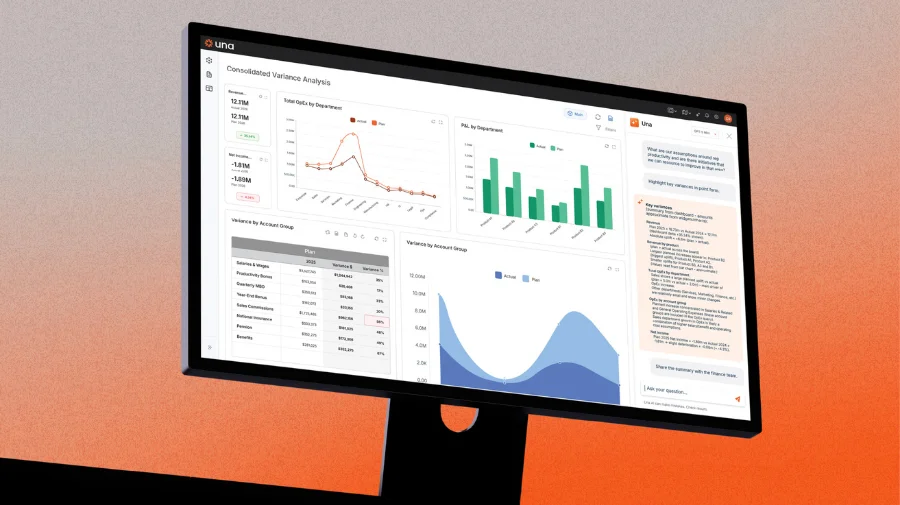
Ready to take control of your budgeting, planning, forecasting and reporting? Schedule a demo and see how Una’s financial planning & analysis software can work for you.
Schedule Demo