Most finance teams believe they are further along the AI maturity curve than they actually are. Bain & Company's 2026 survey of 100+ CFOs found that only 15–25% have scaled AI across finance functions and only 31% are satisfied with their AI outcomes. The four phases of AI in finance are not only a roadmap for the future, they are a diagnostic for where you stand today.
Phase 1: Experimentation
What it looks like: Individual analysts are using AI tools (ChatGPT, Copilot, or similar) on an ad hoc basis. There is no standardization, no shared prompts, no institutional view on what AI should be doing in finance. Usage is driven by curiosity, not strategy.
What finance teams in Phase 1 say: "We're piloting AI." "A few people on the team are using it." "We're still figuring out the use cases."
What is actually happening: AI is being used as a personal productivity tool for individual tasks (i.e. drafting emails, summarizing documents, cleaning up commentary). The output stays with the individual. The organization does not benefit and no new capability is being built.
The ceiling: Phase 1 creates no compounding value. When the analyst who figured it out leaves, the capability leaves with them.
The hard truth: Most organizations that believe they have moved past Phase 1 have not. Scattered individual usage with no governance, no shared standards, and no institutional ownership is Phase 1, regardless of how long it has been going on.
Phase 2: Operationalization
What it looks like: Specific, high-value finance workflows have been redesigned around AI. Variance commentary, forecast narrative, close reporting, and data reconciliation are being handled with standardized AI-assisted processes. The team has shared prompt libraries. There is a designated owner for AI workflow quality.
What finance teams in Phase 2 say: "We have AI embedded in our close process." "We've cut reporting time by 40%." "We have standard templates the whole team uses."
What is actually happening: AI is producing measurable efficiency gains in defined workflows. The finance team is producing the same deliverables faster. Senior capacity is being partially freed. But the work AI is doing is still essentially the same work, faster, but not fundamentally different.
The ceiling: Phase 2 creates efficiency. It does not yet create strategic differentiation. The team is still primarily a reporting and analysis function. The CFO is still spending most of their board time explaining the past.
The signal that you are ready to move to Phase 3: Your team has consistent, high-quality AI output across the core reporting cycle, and the freed time is being absorbed by work that still looks like the old work rather than genuinely higher-order strategic analysis.
Phase 3: Integration
What it looks like: AI is connected to live financial data systems. Variance analysis, driver commentary, forecast updates, and performance alerts are generated automatically from structured data pipelines, not from manual data exports fed into a prompt. Finance has a working architecture: data in, insight out, with human review at the synthesis layer.
What finance teams in Phase 3 say: "Our AI connects directly to the ERP." "We get automated variance flags within hours of close." "The system generates the first draft. We review and approve."
What is actually happening: The finance team has shifted from being producers of analysis to being editors and strategic interpreters of AI-generated analysis. The volume of insight produced has increased dramatically without a corresponding increase in headcount. The finance team is beginning to have different conversations with the business, more forward-looking, more prescriptive, more connected to operating decisions.
The ceiling: Phase 3 creates scale and speed. It begins to change the nature of the finance function's work. But it still operates within the existing organizational model, the same reporting cadences, the same team structures, the same definition of what finance is for.
The hard work of Phase 3: The technical integration is not the hard part. The hard part is building the governance, the data quality standards, and the human review protocols that make AI-generated financial insight reliable enough to go directly to the CFO and the board.
Phase 4: Transformation
What it looks like: AI has changed what the finance function is, not just how it operates. The team is smaller and more senior. The CFO is functioning as a strategic co-pilot to the CEO, not a reporting function head. Finance is driving operating decisions in real time rather than explaining the past at month-end. The planning cadence has shifted from annual/quarterly to continuous. Scenario modeling happens on demand, not on a fixed schedule.
What finance teams in Phase 4 say: "We killed the monthly close as a deliverable. Stakeholders see performance in real time." "Our FP&A headcount is 40% smaller than three years ago but we cover 3x the analytical ground." "The CFO presents forward-looking strategy, not backward-looking variance."
What is actually happening: The finance function has been fundamentally redesigned around what AI handles and what humans handle. AI owns data processing, pattern detection, routine analysis, and first-draft narrative. Humans own judgment, strategic synthesis, stakeholder communication, and high-stakes decision framing. The organizational structure, the team composition, and the value proposition of finance have all changed.
The honest reality about Phase 4: Very few finance functions are here. The ones that are did not get there by deploying better tools. They got there because the CFO made a deliberate, multi-year commitment to redesigning the function, not just automating it.
Best Practices for Advancing Through the Phases
Where Are Most Finance Teams Today?
Based on the available data, the distribution is roughly as follows:
PhaseEstimated % of Finance TeamsPhase 1~35%Phase 2~40%Phase 3~15–20%Phase 4~5%
The Wolters Kluwer Future Ready CFO report confirms this pattern: nearly a fifth (18%) of finance organizations identify as digitally advanced. Bain's data shows that CFO satisfaction with AI outcomes exceeds 60% at firms in the top quartile of AI maturity compared to just 25% at companies still piloting.
The satisfaction gap is not about tools. It is about scale, governance, and the organizational discipline to move through the phases deliberately rather than jumping to the headline technology.
The Diagnostic: Where Are You?
Answer these four questions honestly:
Take the assessment here and find out how you score and get recommendations on how to get to the next level. https://benchmark.una.ai/
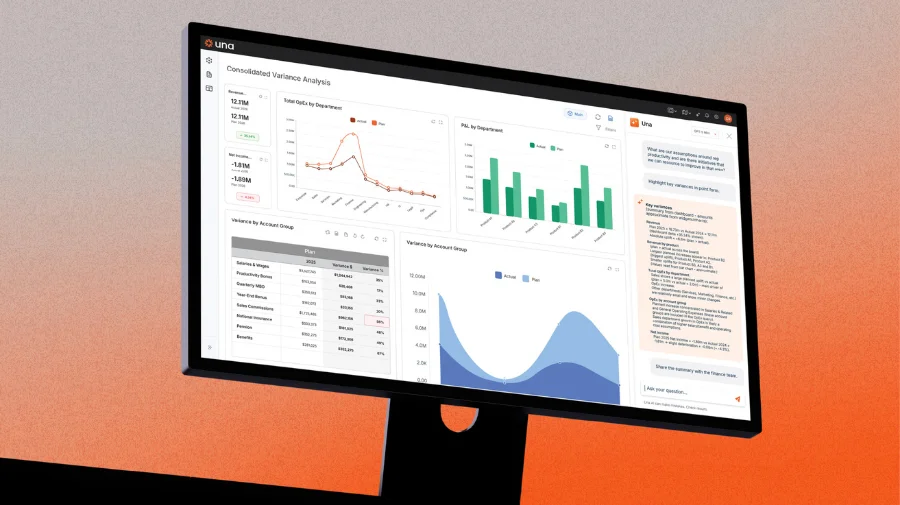
Ready to take control of your budgeting, planning, forecasting and reporting? Schedule a demo and see how Una’s financial planning & analysis software can work for you.
Schedule Demo