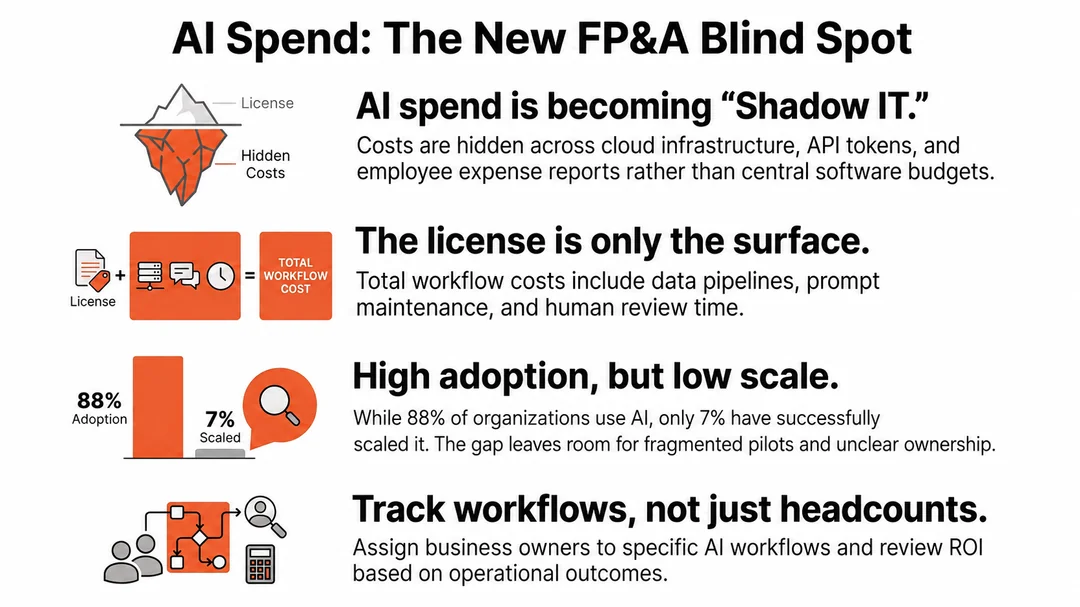
Shadow IT used to mean a few unapproved SaaS subscriptions buried in expense reports.
AI is making the problem harder to see.
Different teams are independently buying copilots, API access, AI add-ons and specialized tools. Some of that spend appears in software budgets. Some lands in cloud infrastructure. Some is hidden inside existing vendor contracts or employee expenses.
The seat license is often only the visible layer.
The full cost of an AI workflow can include:
That creates an allocation problem for FP&A.
A flat software allocation based on headcount may work for conventional SaaS, but it tells us very little about AI. Two departments with the same number of employees can have completely different consumption patterns—and completely different returns.
The more useful unit of analysis may be the workflow.
Instead of asking, “How much are we spending on AI?”, finance could ask:
The adoption-versus-value gap is already visible. McKinsey’s 2025 survey found that 88% of respondents said their organizations regularly used AI, but only 7% said it had been fully scaled. That is a lot of room for fragmented pilots and unclear ownership.
What FP&A needs is a lightweight operating model for AI spend:
The goal shouldn’t be to centralize every experiment or slow adoption. It should be to make ownership, cost and value visible before AI becomes an unmanaged line item across the P&L.
How Una AI can help
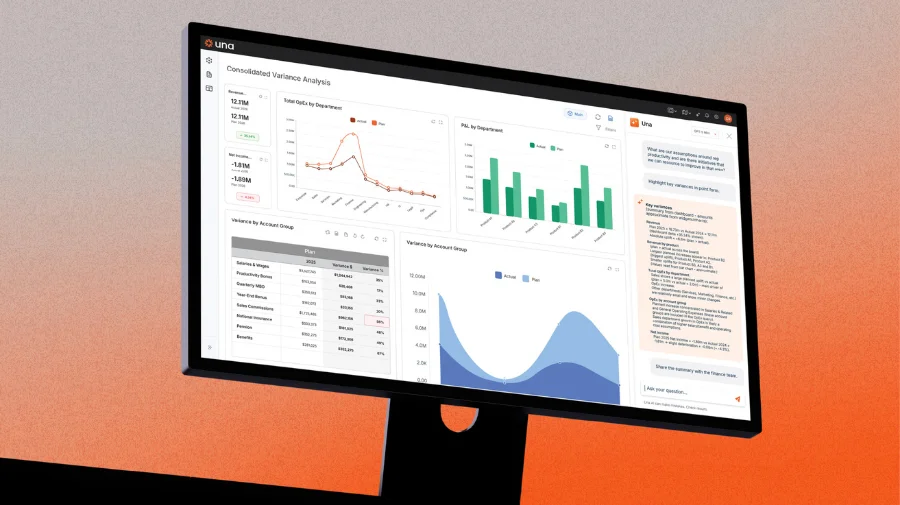
Una AI gives finance teams a connected environment for bringing financial and operational data together. FP&A teams can incorporate AI costs into forecasts, compare spending with expected outcomes and model the impact of scaling—or retiring—individual workflows. While technology cannot replace clear ownership and governance, Una AI provides the planning, reporting and scenario-modeling foundation needed to manage AI investment with greater visibility and discipline.
Ready to take control of your budgeting, planning, forecasting and reporting? Schedule a demo and see how Una’s financial planning & analysis software can work for you.
Schedule Demo